


Last Updated: October 25, 2026
Quick Summary
To verify first aid compliance, confirm your workplace risk level and kit type against CSA Z1220 standards, validate that all certified responders hold current approved certificates, physically audit kit contents and expiration dates quarterly, and maintain documented inspection records with certification numbers and verification dates.
- Classify your workplace as low-risk or high-risk and count workers per shift to identify the correct CSA Z1220 kit type required.
- Verify each first aid certificate by confirming the holder's name, course type, expiration date, provider approval, and certification number against your provincial regulator's list.
- Physically inspect your first aid kit every three months to check expiration dates, verify all required items are present, and confirm accessibility and signage.
- Create a spreadsheet tracking each certified responder's name, course type, certification number, issue date, and expiration date for quick compliance visibility.
- Document all inspections, certifications, and restocking actions in a records register and maintain a repeatable audit cycle to produce evidence for regulators.
Table of Contents
- Why Verifying First Aid Compliance Matters
- Step 1: Confirm Your Workplace First Aid Requirements
- Step 2: Verify First Aid Certificate Credentials
- Step 3: Audit Your First Aid Kit Contents Checklist
- Step 4: Perform a First Aid Kit Inspection Checklist
- Step 5: Check Certification Numbers and Expiration Dates
- Step 6: Document Compliance Records and Audit Trails
- Building Your Workplace First Aid Compliance Program
- Frequently Asked Questions
Why Verifying First Aid Compliance Matters
Workplace accidents happen fast, and your team needs properly stocked supplies and trained responders immediately. A kit on the shelf isn't enough, it must be compliant, current, and ready to work. (Source: CSA Z1220 standard)
Many workplaces assume their first aid setup is fine until an incident forces a check, by then it's too late. Expired supplies, missing items, or kits that don't meet CSA standards create serious liability.
This guide walks you through the exact steps to verify first aid compliance, from confirming your kit type to documenting your audit trail.
Step 1: Confirm Your Workplace First Aid Requirements
First aid kit requirements depend on three factors: number of workers, workplace risk level, and province or territory.
Start by classifying your workplace risk level.
Next, count your workers per shift, this drives kit size. A CSA Z1220-24 Type 2 Small First Aid Kit - 2-25 Workers suits smaller low-risk teams; larger teams need medium or large kits.

Provincial requirements add another layer. Quebec and Nova Scotia have specific CSA Z1220-24 rules, while British Columbia, Ontario, and other provinces follow their own standards.
Once you know your risk level, worker count, and province, you can identify the correct kit type, your baseline for all future compliance checks.
Step 2: Verify First Aid Certificate Credentials
Every workplace needs at least one person trained in first aid, and many require multiple certified responders across shifts. To verify compliance, confirm three things: the certificate is genuine, the provider is approved, and the course matches your risk level and jurisdiction. Maintaining a safe environment extends beyond medical readiness to include hygiene protocols, which is why you must also verify sanitizer safety to ensure all protective supplies meet current health standards.
Confirm the certificate details
Ask each employee for their original certificate or a clear scan. Check these fields against your employment records:
- Certificate holder's name matches their legal name and employment file exactly, including hyphenated or multi-part surnames.
- Course type is appropriate for the role. Standard First Aid typically covers wound care, CPR, and recovery position; CPR-only certificates do not include first aid content. AED training is often bundled with CPR but should be listed separately if your emergency response plan relies on it.
- Issue date and expiration date are both present. Most workplace first aid certifications remain valid for three years, though some CPR levels expire sooner. Treat any certificate without a visible expiration date as unverified until the provider confirms it.
Validate the issuing organization
A certificate is only as good as the organization that issued it. In most jurisdictions, first aid training must come from a provider approved by the provincial or territorial labour ministry, workers' compensation board, or a recognized national body such as the Canadian Red Cross or St. John Ambulance. Approval can lapse.
Use this sequence to validate a provider:
- Identify the regulator for your jurisdiction. First aid training approval sits with the provincial or territorial labour ministry or the workers' compensation authority. Confirm which body approves training for your industry.
- Check the provider against the regulator's list. Most regulators publish a searchable registry of approved training providers. If the provider is not listed, ask for their approval number and the date it was last renewed.
- Confirm the course is on the approved list. A provider may be approved for CPR but not for Standard First Aid, or approved for a lower-risk audience only. Match the course name on the certificate to the approved course list.
- Contact the provider directly. Legitimate providers maintain issuance records and can confirm a certificate number, holder name, and completion date. Ask for written confirmation and keep it with your records.
Handle unverifiable, expired, or disputed credentials
A failed check isn't the end of the process. Work through a short escalation path:
- Expired certificate: Remove the employee from the certified responder list until recertification is complete. Schedule the next available course and record the gap.
- Unverifiable certificate: Ask the employee to request written confirmation from the provider. If the provider cannot confirm issuance within a reasonable period, treat the certificate as invalid and arrange retraining.
- Disputed or suspicious certificate: Do not confront the employee informally. Escalate to HR, document the concern, and give the employee an opportunity to provide original documentation. Keep the review confidential.
Record the verification result
For each employee, record the certificate details, provider approval check, verification date, and outcome. A status of verified, pending, or failed is enough if you also note the next action and its due date. This record becomes your inspection evidence and triggers recertification reminders.
Step 3: Audit Your First Aid Kit Contents Checklist
A compliant first aid kit must contain specific items in specific quantities, as listed in the CSA Z1220 standard. Verify your kit actually contains them.
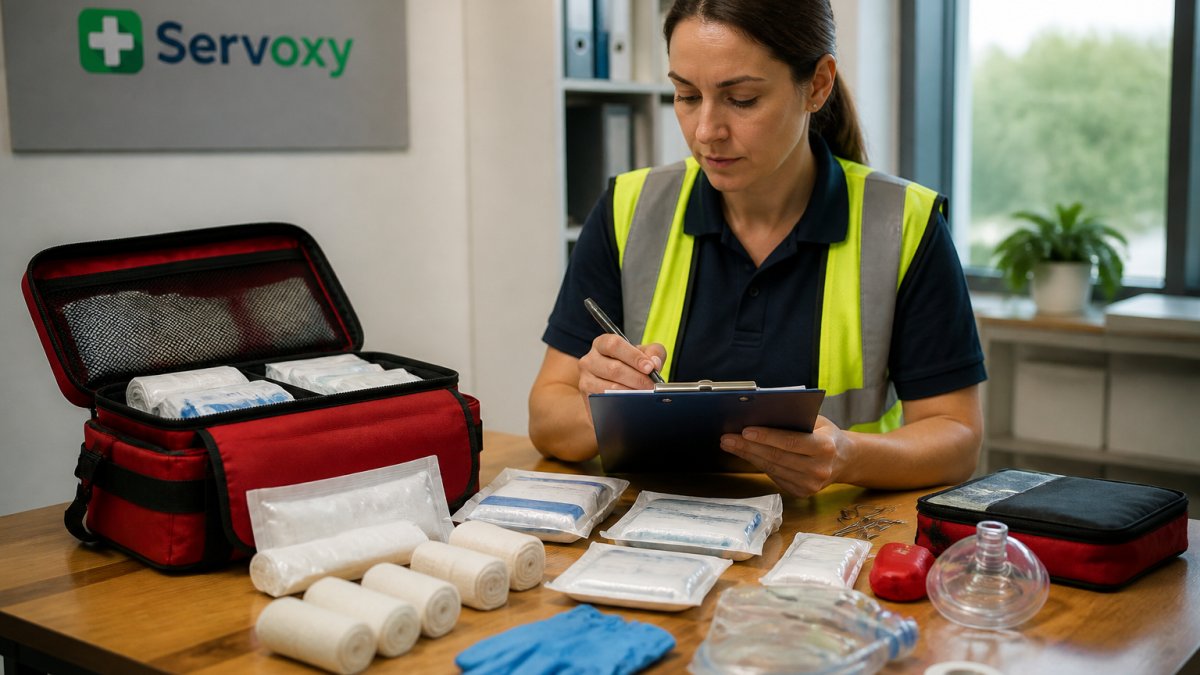
Open your first aid kit and physically count the contents. Don't assume, verify. CSA-compliant kits for low-risk workplaces typically include:
- Adhesive bandages (various sizes)
- Sterile gauze pads
- Elastic bandages
For higher-risk workplaces, kits also include tourniquet, larger sterile dressings, abdominal pads, and additional supplies. The exact contents depend on your kit type and size.
Compare your kit's contents to the CSA Z1220 checklist for your kit type. You can review a bilingual first aid kit example to verify contents and compliance standards.
Many workplaces find it easier to use a pre-assembled, CSA-compliant kit from a trusted supplier.
Step 4: Perform a First Aid Kit Inspection Checklist
Compliance isn't a one-time check, it's ongoing.
Create a simple inspection routine. Check these items every three months:
- Expiration dates on all supplies (bandages, ointments, antiseptic wipes)
- Physical condition of supplies (packaging intact, no moisture damage)
- Signage is visible (staff know where the kit is located) (Source: provincial labour ministry website)
Document each inspection with the date, inspector, findings, and restocking actions, this becomes your proof of compliance during audits.
CSA Z1220-24 Type 2 Small First Aid Kit – 2-25 Workers →
Make restocking easy by replacing used or expired supplies immediately.
Proper signage matters too. A Double-Sided Projecting First Aid Sign - 6" X 6" ensures everyone knows where to find your kit in an emergency.

Step 5: Check Certification Numbers and Expiration Dates
Every first aid certificate has a unique certification number tying it to the provider's records.
Create a spreadsheet with the following information for each certified responder:
| Employee Name | Course Type | Certification Number | Issue Date | Expiration Date | Verified |
|---|---|---|---|---|---|
| Sarah Johnson | Standard First Aid + CPR | CSA-2024-156789 | June 15, 2024 | June 15, 2027 | Yes |
| Marcus Chen | CPR Level C | RCS-2025-045623 | March 10, 2025 | March 10, 2027 | Yes |
| Lisa Rodriguez | Standard First Aid | STJ-2023-987654 | September 22, 2023 | September 22, 2026 | No - Expired |
This table gives you a quick visual check of who is certified and who needs recertification, and creates a compliance record for regulators or insurance auditors.
Set calendar reminders for expiration dates, if Sarah's certification expires June 15, 2027, schedule her recertification for May 2027 to prevent gaps in trained responder coverage.
For remote or multi-site operations, maintain this record centrally.
Step 6: Document Compliance Records and Audit Trails
Compliance verification means nothing without documentation. When a regulator inspects or an incident occurs, your records prove you took compliance seriously. The common gap is keeping records without a repeatable process for auditing them and producing them on request.
Build a records register
Start with a single register listing every record type, where it is stored, who owns it, and how long it is retained. A practical register covers:
- First aid kit inventory lists for each kit and each site, showing the expected contents against the applicable CSA kit type.
- Inspection records with the date, inspector name, findings, and restocking actions.
- Employee certification files containing the verified certificate, the provider approval confirmation, and the verification date.
Store originals securely and back up digital copies. For multiple sites, keep a separate register per location plus a central index for the full picture.
Run a repeatable audit
An audit isn't a one-time cleanup. Schedule it on a predictable cycle that produces the same evidence each time. A workable pattern is:
- Monthly spot-check: Confirm each kit is accessible, signed, and not blocked by equipment. Record the check even when nothing is wrong.
- Quarterly full inspection: Open each kit, count contents against the inventory list, check expiration dates, and restock. File the completed checklist.
- Annual certification review: Reconcile the certification register against the current employee list. Identify expired, expiring, and unverified certificates, and schedule recertification before the expiration date.
- Post-incident review: After any first aid use, confirm the kit was restocked, the responder's certification was current, and the incident report is complete.
Each audit should produce a dated record with a named owner. If a regulator asks who checked a kit on a given date, the answer should be in the file, not in someone's memory.
Limit access to personal data
Employee certification information is sensitive personal information. Apply the same discipline you would to any personnel file:
- Restrict access to HR and safety personnel with a legitimate need.
- Password-protect digital records and use role-based permissions where your tools allow it.
- Store original certificates in a locked cabinet rather than on a shared shelf.
Prepare for an inspection
When a regulator arrives, they'll want to see that your kits match the required type, inspections are current, and certified responders are available on each shift. Walk through your internal audit sequence: confirm the kit, the inspection record, the responder list, and the certification evidence. If a record is missing, say so and note the corrective action rather than producing an incomplete file.
Building Your Workplace First Aid Compliance Program
Verification is the foundation. But true compliance means maintaining your systems over time. Here's how to build a program that stays compliant:
Assign clear responsibility. One person should own first aid compliance, your safety officer, HR manager, or operations lead. They track certifications, schedule inspections, and maintain records.
Schedule recurring tasks. Quarterly kit inspections, annual recertification reviews, and monthly spot-checks of accessibility. Calendar these so they happen consistently.
Partner with a trusted supplier. When you need to restock or replace kits, work with a provider who understands CSA compliance.
Review after incidents. Every time first aid is used, assess what worked and what didn't.
Compliance isn't a burden, it's insurance.
Frequently Asked Questions
How do I verify a first aid certificate is legitimate?
Check the certificate holder's name, certification number, issuing organization, and expiration date against the training provider's records. Request proof directly from the organization that delivered the course. Verify the training provider is accredited by a recognized body in your province. Ask for a copy of the course completion documentation and cross-reference it with the issuing organization's database if available. Many provinces maintain registries of approved first aid trainers.
What should be included in a first aid kit contents checklist?
A CSA Z1220-compliant kit must include sterile bandages, gauze pads, antiseptic wipes, adhesive tape, gloves, scissors, a CPR shield, an emergency blanket, and a tourniquet. The exact quantities depend on your kit type and worker count. Our CSA Z1220-24 Type 2 Small Kit for 2-25 workers includes all required items in a durable plastic case. Verify contents during monthly inspections and replace expired or used items immediately to maintain compliance.
How often should I inspect workplace first aid kits?
Inspect first aid kits monthly and after each use. Check for expired items, missing supplies, and physical damage to the kit container. Document each inspection with the date and inspector name. Replace any used or damaged items and remove expired medications or dressings. Many employers conduct quarterly audits in addition to monthly checks to ensure consistent compliance and readiness for emergencies.
What are the main first aid requirements for workplaces?
Employers must provide appropriate first aid kits, trained first aid attendants, and accessible first aid equipment based on workplace hazards and worker count. CSA Z1220 standards govern kit selection by risk level and number of employees per shift. Provinces may have additional requirements; Quebec and Nova Scotia follow CSA Z1220-24, while other provinces use CSA Z1220-17. Conduct a workplace risk assessment to determine the correct kit type for your operation.
