


Last Updated: October 30, 2026
Quick Summary
A CSA compliant first aid kit is a workplace kit whose contents, classification and sizing meet the CSA Z1220 standard published by the Canadian Standards Association. Canadian employers use it to choose kit contents, the number of kits needed and the kit type that matches their risk level.
- Kit type reflects workplace risk: Type 1 is personal, Type 2 is low-risk, Type 3 is moderate-to-high risk.
- Kit size is set by the largest number of workers on any single shift, not total headcount.
- Provincial requirements differ, so confirm the kit configuration against each province where you have employees.
- Verify labeling, contents list, provincial configuration and documentation before purchasing a kit.
- Inspect kits monthly and after any use, and restock promptly.
Table of Contents
- What CSA Z1220 Means for Your Workplace First Aid Kit
- CSA First Aid Kit Type 1, 2, and 3: Choosing the Right Class
- CSA First Aid Kit Contents: What Must Be Included
- CSA First Aid Kit Size Selection by Worker Count and Shift Coverage
- Remote, Mobile, and Multi-Site Workplace Kit Planning
- Workplace First Aid Kit Inspection Checklist and Restocking Schedule
- Ordering a CSA-Compliant Kit for Your Site Today
- Frequently Asked Questions
What CSA Z1220 Means for Your Workplace First Aid Kit
A CSA compliant first aid kit is a workplace first aid kit whose contents, classification and sizing meet the requirements of the CSA Z1220 standard, published by the Canadian Standards Association.
The standard matters because provincial workplace safety regulators generally point employers to it for minimum first aid requirements. Many provinces reference CSA Z1220 directly, and Canadian Standards Association first aid standards sets out how kits are classified. You can also review our guide to verify first aid compliance step by step.
Two terms come up constantly. The first is kit type, which reflects the risk level of the workplace. The second is kit size, which reflects how many workers a kit must serve per shift.
CSA First Aid Kit Type 1, 2, and 3: Choosing the Right Class
Type 1 is the personal kit.
Type 2 is the low-risk workplace kit. Offices, retail floors, libraries, and similar environments where the realistic injuries are cuts, scrapes, and minor burns generally fall here.
Type 3 is the moderate-to-high-risk kit. Construction sites, manufacturing floors, warehouses, and industrial operations where lacerations, crush injuries, burns, eye injuries, or falls are realistic possibilities generally fall here.
A common pattern is for employers to buy a Type 2 kit because the price is lower and the box looks full, then fail an inspection because the site's hazard assessment called for Type 3. The kit type must follow the documented risk assessment, not the budget line.
Assessing Workplace Risk Level and Hazards
Choosing a kit type starts with a documented hazard assessment.
The highest-risk area in a workplace generally sets the kit type for that workplace.
Review the assessment when work processes change, when new equipment is introduced, or after any incident that reveals a gap. A kit type chosen three years ago for a different operation may no longer match the work.
Provincial Requirements Across Canada
Workplace first aid is regulated provincially, so the legal requirements differ by jurisdiction even though the CSA standard provides a common reference point. Some provinces reference CSA Z1220 directly in their first aid regulations; others set their own kit contents and type rules and use the CSA standard as guidance rather than as the legal text.
For a multi-province employer, the practical approach is to build a jurisdiction matrix: one row per province where you have employees, one column for the first aid regulation or authority that applies, one column for the kit type and contents rule, and one column for the number of kits or first aiders required. Maintaining this level of regulatory precision ensures that your site remains compliant while you integrate other necessary construction safety equipment to protect your workforce.
Our Type 1 personal kit is available in a configuration built for Québec and Nova Scotia requirements, and the Type 2 small kit is priced at $52.00 CAD. If you operate in more than one province, confirm the configuration on each kit against the matrix before ordering.
CSA First Aid Kit Contents: What Must Be Included
Compliant kits must contain the supplies the CSA standard specifies for their type and size.
Core categories in a compliant kit:
- Wound care: sterile gauze pads, adhesive bandages in assorted sizes, rolled bandages, and sterile dressings
- Bleeding control: larger dressings and, in higher-type kits, a tourniquet
- Burn care: burn dressings or gel-soaked pads
How the types differ in practice:
- Type 1 personal kits carry a compact subset of the core categories sized for one worker. They are not intended to serve a fixed workplace.
- Type 2 kits carry the full core set at quantities scaled to the worker range. They handle minor wound care and bleeding control but generally do not include splinting material or a tourniquet.
- Type 3 kits add a wider range of dressings, splinting material, and larger consumable quantities, and may include a tourniquet depending on the configuration.
Our CSA Z1220-24 Type 2 small kit includes sterile dressings, nitrile gloves, a CPR shield with one-way valve, bandage scissors, antimicrobial wipes, an emergency blanket, and a Combat Application Tourniquet. The CSA Z1220 Type 3 intermediate small kit is priced at $62.00 CAD. Compare each kit's contents list against the CSA type you need rather than the product name alone.
How to Verify CSA Compliance When Purchasing
A kit labeled "CSA compliant" is a claim, not proof. Before you buy, verify four things:
CSA Z1220-24 Type 2 Small First Aid Kit – 2-25 Workers →
- Labeling. The kit or its packaging should identify the CSA standard it is built to and the kit type and worker range it is rated for. A kit that does not state its type and size cannot be checked against your assessment.
- Contents list. Ask for the full contents list with quantities, not just categories. Compare it against the CSA type you need and against your provincial requirements.
- Provincial configuration. If you operate in a province with configured requirements, confirm the kit is built for that configuration. A default national kit may not satisfy a province that adds or reconfigures items.
- Documentation. Keep the contents list, the standard reference, and the purchase record on file with your risk assessment. If an inspector questions the kit, the documentation is what shows the choice was deliberate.
When you receive a kit, check the contents against the listing and against the standard before placing it in service. Missing items are a common reason kits fail inspection, and a kit that arrives short is easier to correct before it is deployed than after an incident.
The core categories every compliant kit should cover are summarised below, with the Type 2 and Type 3 differences drawn from the article.
| Category | What it covers | Type difference |
|---|---|---|
| Wound care | Sterile gauze, adhesive bandages, rolled bandages | Present in all types |
| Bleeding control | Larger dressings | Tourniquet in higher-type kits |
| Burn care | Burn dressings or gel-soaked pads | Present in all types |
| Eye care | Eye pads, eyewash where required | Eyewash where required |
| Infection control | Nitrile gloves, antimicrobial wipes | Present in all types |
| CPR barrier | Shield or mask with one-way valve | Present in all types |
| Tools | Bandage scissors | Splinting material in higher-type kits |
| Rescue supplies | Emergency blanket | Additional items in higher-type kits |
CSA First Aid Kit Size Selection by Worker Count and Shift Coverage
Kit size determines how many workers a kit is intended to serve, usually stated as a worker range per shift.
Our Type 2 small kit covers 2 to 25 workers and our Type 2 medium kit covers 26 to 50 workers. Larger sites typically need multiple kits placed in different zones. Confirm the worker range printed on any kit before buying, and check whether your provincial rules require more than one kit at larger headcounts.
Do not split a single shift's workforce across kits to stay under a size threshold without checking the rules. Regulators look at actual coverage, and a site with 60 workers on one floor generally cannot justify a kit sized for 25.
Remote, Mobile, and Multi-Site Workplace Kit Planning
Remote construction sites, mobile crews and multi-site operations need a different approach. A single kit at a headquarters does not cover a worker three hours away.
Practical steps include assigning a kit to each vehicle or crew, placing kits at each active site, and keeping a central inventory so you know where every kit is.
Remote sites also face environmental stress. Choose kits with durable packaging and check contents regularly, since heat, cold and moisture can degrade supplies faster than in an office.
Workplace First Aid Kit Inspection Checklist and Restocking Schedule
A compliant kit has to stay compliant. Inspect kits on a fixed schedule, typically monthly, and after any incident that uses supplies. Use this checklist at each inspection:
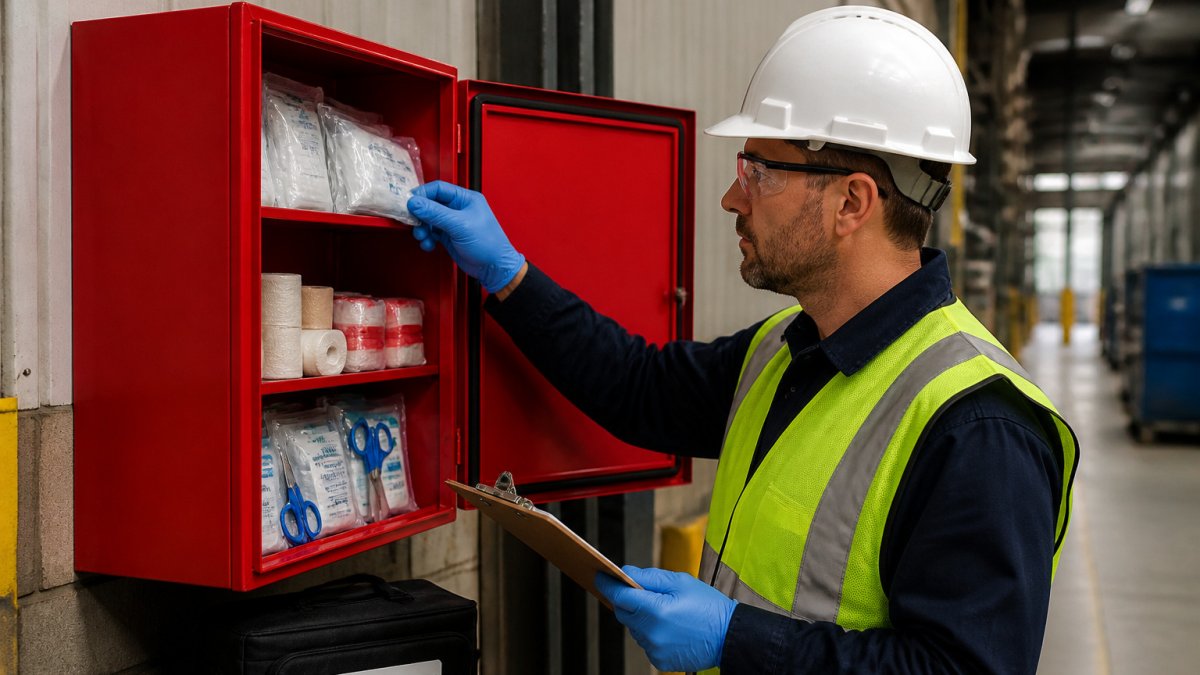
- Confirm the kit type and worker range still match your current workforce
- Check every item against the contents list, including quantities
- Verify that sterile packaging is intact and within expiry dates
Restock promptly after every use rather than waiting for the next scheduled inspection. Set a reorder threshold so that consumables such as gloves and bandages are replaced before they run out. Keep a log, because a dated record is the simplest evidence that your kits are maintained.
Ordering a CSA-Compliant Kit for Your Site Today
Once you have your kit type from the risk assessment, your worker range from your shift schedule and your provincial requirements confirmed, ordering is straightforward.
Before you order, confirm the kit's configuration matches your province. Keep your risk assessment and kit records together, so the purchase, inspection and restocking history is in one place. Shop our range to find the right kit for your workforce.
Frequently Asked Questions
What does CSA compliance mean for a workplace first aid kit?
CSA compliance means the kit's type, size and contents meet the CSA Z1220 standard, the first aid kit standard published by the Canadian Standards Association. The standard sets minimum contents for each kit type and links kit selection to workplace risk and the number of workers per shift. Provincial occupational health and safety rules then decide whether a kit is mandatory and how it must be stocked. Ask suppliers for documentation showing which CSA edition and kit type the product was assembled to, not just a compliance claim on the label.
What items are required in a CSA-compliant first aid kit?
A CSA-compliant kit contains a defined list of supplies that varies by kit type. Typical contents include adhesive bandages, sterile gauze pads, roller bandages, triangular bandages, adhesive tape, antiseptic wipes, nitrile gloves, scissors, forceps, a CPR barrier device and an emergency blanket. Higher kit types add items such as tourniquets, splints and additional dressings. Check the exact quantities and item list against the CSA Z1220 table for your kit type, because quantities are specified, not optional.
How do I choose the right CSA first aid kit class for my workplace?
Start with a workplace risk assessment that classifies your site as low, moderate or high risk based on the hazards your workers face. Then count the workers on your largest shift, since kit size depends on headcount. Low-risk offices typically use a Type 2 kit, while higher-hazard sites such as construction or industrial plants generally need an intermediate or advanced kit. Confirm the final choice against your provincial OHS regulator, because some provinces set kit requirements directly.
What are the differences between CSA first aid kit Types 1, 2, and 3?
Type 1 is a personal kit for a single worker, usually low-risk and portable. Type 2 is a basic workplace kit for low-risk environments, sized by worker count. Type 3 is an intermediate kit for moderate to high-risk workplaces and includes a broader range of supplies. The types differ in both contents and quantities, so a Type 3 kit is not simply a larger Type 2 kit. Match the type to your risk assessment rather than to budget alone.
How often should workplace first aid kits be inspected and restocked?
Inspect kits at least monthly and restock them immediately after any use, because a partly used kit may be missing items the next responder needs. Check expiry dates on sterile dressings, ointments and wipes, and replace damaged packaging. Record each inspection with a date and the name of the person who checked the kit. Your provincial OHS regulator may set specific inspection expectations, so confirm the requirement for your province.
Does every workplace need a CSA-compliant first aid kit?
Most Canadian employers must provide first aid supplies, but the exact obligation depends on the province or territory and on the workplace's size and hazards. Some jurisdictions require a kit built to the CSA Z1220 standard, while others set their own minimum contents. Check the occupational health and safety rules where your workers are based, and treat the CSA kit as the practical benchmark if you are unsure.
What is the difference between CSA Z1220-17 and CSA Z1220-24?
CSA Z1220-24 is the newer edition of the standard, and some provinces have adopted it for workplace first aid kit selection. Products may be labelled to either edition, so check which edition a kit was assembled to and confirm that edition is accepted in your province. Older stock built to the earlier edition may still be acceptable where the regulator permits it, but verify this before buying in bulk.
How many first aid kits does a workplace need?
The number of kits depends on how many workers you have, how many shifts run, and how spread out your site is. A single building with a small team may need one kit, while a large plant or a site with several floors or separate work areas often needs kits in each zone so responders can reach one within a short distance. Your risk assessment and the CSA kit size tables set the baseline, and you should add kits where distance or noise makes a central kit hard to reach.
