


Last Updated: October 23, 2026
Quick Summary
First aid kit procurement starts by assessing your workplace risk level and worker count, then selecting a kit type that matches your actual hazards and complies with provincial CSA standards. Request detailed proposals from 2-3 vendors with transparent pricing, verify compliance documentation, and establish a restocking schedule to keep supplies current and compliant.
- Risk classification in Canada includes low-risk, medium-risk, and high-risk environments, each requiring different kit types.
- Request itemized pricing from vendors and verify CSA certification documents and Health Canada licensing before ordering.
- Set up monthly or quarterly inspection schedules to track expiry dates and maintain compliance.
- Customization options like branded packaging and bilingual labels are available but require minimum orders and longer lead times.
Table of Contents
- Assess Your Workplace First Aid Kit Requirements
- Build Your First Aid Kit Procurement Checklist
- Select the Right First Aid Kit Contents Checklist
- Evaluate and Compare First Aid Kit Vendors
- Implement a First Aid Kit Restocking Service
- Place Your Custom First Aid Kit Order
- Frequently Asked Questions
Assess Your Workplace First Aid Kit Requirements
Selecting the right custom first aid kit procurement strategy starts with understanding exactly what your workplace needs. This isn't a one-size-fits-all decision. A small office has completely different safety demands than a remote construction site or a fleet of vehicles operating across the country. (Source: CSA Z1220 standards)
The first step is straightforward: determine your risk level and worker count. According to WorkSafeBC First Aid Requirements, workplace first aid kit selection depends on workplace hazards, number of workers per shift, and distance to nearest medical facility.
Determine Risk Level and Worker Count
Risk classification in Canada is typically broken into three categories: low-risk, medium-risk, and high-risk environments. Low-risk workplaces include offices, retail stores, and schools. Medium-risk environments cover warehouses and light manufacturing. High-risk sites include construction, mining, and chemical handling operations.
Worker count matters because larger teams need more supplies and often multiple kit locations. A 5-person office needs different contents than a 50-person warehouse.
Document your current headcount per shift. Include contractors, temporary staff, and remote workers who visit your main location. This number determines which kit size you'll need across your procurement process.
Check Provincial and CSA Compliance Standards
Compliance is non-negotiable. Quebec and Nova Scotia use the updated CSA Z1220-24 standard, while British Columbia follows WorkSafeBC regulations.

This matters because a kit that meets one standard might not meet another. The CSA Z1220 First Aid Kit Standards outlines specific requirements by risk level and worker count.
Pull your provincial workplace safety regulation. Note the specific CSA version required in your jurisdiction. This becomes your compliance baseline for every kit you procure.
Build Your First Aid Kit Procurement Checklist
A procurement checklist prevents oversights that could leave your workplace non-compliant or underprepared. Think of it as your decision framework before you contact any supplier.
Document Hazards and Injury Scenarios
Start by listing the actual hazards in your workplace. What injuries are most likely? In a warehouse, that might be cuts, sprains, and eye injuries.
This exercise isn't theoretical. It directly influences which supplies belong in your kit. A Type 3 intermediate kit adds trauma supplies like tourniquets and larger dressings.

Document 3-5 realistic injury scenarios. For each one, ask: what supplies would a first responder need? This list becomes your content requirements when you approach suppliers.
List Required Supplies and Components
Once you know your hazards, list the supplies your kit must contain. Start with the CSA standard for your risk level and worker count.
For example, if you operate vehicles, you might add extra antiseptic wipes and blister treatments. If you handle chemicals, you might add eye wash and larger sterile compresses.
Create a master supply list organized by category: adhesive bandages, gauze, antiseptics, tools, emergency supplies. Include quantities. This becomes your specification when requesting proposals from suppliers.
Select the Right First Aid Kit Contents Checklist
Not every kit is appropriate for every workplace. Matching kit type to your actual risk level ensures you're compliant without overpaying for unnecessary supplies.
Match Kit Type to Workplace Risk Classification
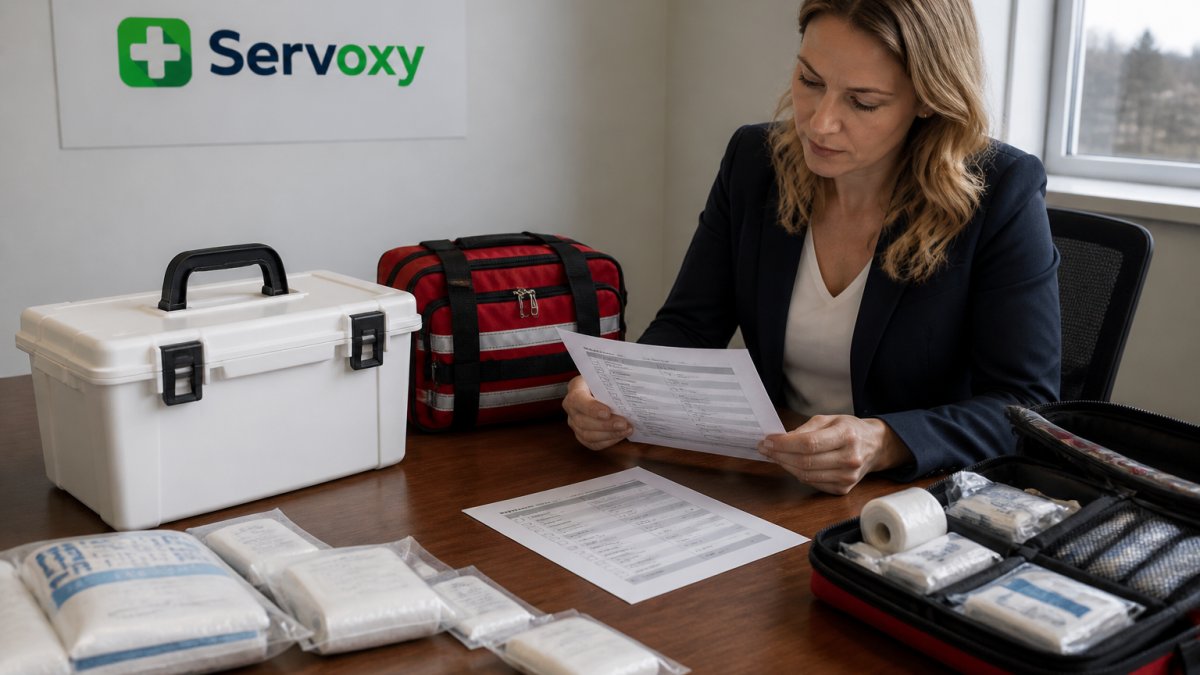
CSA defines three kit types. Type 1 (basic) is rarely used in commercial settings. Type 2 (basic) suits low-risk environments with minor injury potential. Type 3 (intermediate) covers moderate to high-risk workplaces where trauma and serious injuries are possible.
The cost difference is meaningful. A CSA Z1220-24 Type 2 Small kit for 2-25 workers runs $52.00 at Servoxy. A Type 3 intermediate kit for the same worker count is $62.00.

The temptation is to buy the highest tier and call yourself safe. An overstocked kit wastes money, expires supplies before use, and creates restocking headaches. A properly matched kit is lean, compliant, and manageable.
Review your risk assessment. Be honest about injury likelihood. Select the kit type that matches your actual workplace, not your worst-case scenario.
Account for Industry-Specific Needs
Standard kits meet baseline requirements. Your industry might demand more. Fleet operations need kits in vehicles, so durability and weather resistance matter.
If you operate in multiple environments, you might need different kit configurations. A truck kit differs from a warehouse kit. A remote site kit differs from an office kit.
Document which kit configuration applies to each location. This prevents ordering the wrong kit type for specific use cases. When you request proposals, specify these variations clearly.
Evaluate and Compare First Aid Kit Vendors
Selecting the right vendor determines whether you get compliant kits, reliable service, and transparent pricing. This is where many procurement managers make costly mistakes by choosing based on price alone.
Request Proposals and Pricing Transparency
Contact 2-3 qualified suppliers and request detailed proposals. Your proposal request should include:
- Your workplace risk level and worker count
- Required kit type and size
- Specific contents list (from your checklist)
- Quantity needed
- Delivery timeline and location
- Restocking service requirements
- Customization or branding needs
Ask for itemized pricing. You should see the cost per kit, any volume discounts, shipping costs, and restocking fees listed separately. Hidden fees buried in "service charges" are a red flag.
Servoxy provides transparent pricing on all CSA-compliant kits. The CSA Z1220 Type 2 Basic Medium First Aid Kit in a 24-unit plastic box is $65.00. A Type 3 Intermediate kit in a soft pack bag runs $70.00. When you compare proposals, ensure other vendors are equally transparent. (Source: provincial workplace safety regulations)
First Aid Kit CSA Z1120-24 Type 2 Low-Risk Environment, Medium (26-50 Workers) →
Verify Compliance Documentation and Certifications
Every kit should come with proof of CSA compliance. Ask suppliers for:
- CSA certification documents
- Health Canada licensing information (if applicable)
- Ingredient or component lists for all supplies
- Expiry dates on perishable items
- Test results or quality assurance documentation
A reputable supplier will provide these without hesitation. If a vendor dodges this request or says "trust us," move on. Compliance documentation protects you legally if an incident occurs.
Servoxy is Health Canada licensed and supplies CSA-compliant kits verified to meet provincial requirements. Each kit ships with clear labeling and content documentation.
Assess Customization and Packaging Options
Standard kits work for most situations. Customization becomes valuable when you need branded packaging, bilingual labeling, or industry-specific contents.
Ask suppliers:
- Can they customize kit contents?
- Do they offer branded packaging or custom printing?
- Can they supply bilingual labels (English/French)?
- What's the minimum order for customization?
- What's the lead time for custom orders?
The 36 Unit First Aid Kit Container with bilingual logo is available for $18.00 as a replacement container. Custom embroidered patches for medical bags start at $50.00 and allow full personalization.
Customization typically costs more but builds brand consistency and professional appearance. For fleet operations or corporate safety programs, it's worth the investment.
| Vendor Evaluation Criteria | What to Look For | Red Flags |
|---|---|---|
| Compliance Documentation | CSA cert, Health Canada license, component lists | Vague claims, no documentation, hesitation |
| Pricing Transparency | Itemized costs, volume discounts listed, no hidden fees | "Call for pricing," bundled fees, unclear breakdowns |
| Customization Options | Branding, bilingual labels, content flexibility | Limited options, long lead times, high minimums |
| Restocking Service | Automated tracking, regular delivery schedules, expiry alerts | Manual ordering only, unreliable delivery, no tracking |
| References | Willing to provide EMS/fire/industrial customers | Reluctant, vague, or no references available |
Implement a First Aid Kit Restocking Service
Procuring the initial kit is one decision. Keeping it stocked and compliant is an ongoing responsibility that many teams underestimate.
Set Up Inspection and Expiry Tracking
First aid supplies expire. Bandages degrade, antiseptic wipes dry out, medications lose potency. An expired kit is not compliant and won't perform when needed.
Establish an inspection schedule. Monthly is ideal for high-use environments. Quarterly works for low-risk offices. Document every inspection: what was used, what expired, what needs reordering.
Many suppliers offer automated restocking services that track expiry dates and deliver fresh supplies on schedule. This removes the manual burden and ensures your kit stays current.
Establish Restocking Schedules and Workflows
Define who orders, who approves, and who receives restocking supplies. A clear workflow prevents delays and duplicate orders.
For small operations, one person can manage restocking. For larger teams, assign responsibility by location. Remote sites might need quarterly bulk shipments. High-traffic facilities might need monthly top-ups.
Document your restocking process:
- Schedule inspection date
- Complete inspection checklist
- Identify expired or used items
- Submit reorder request to supplier
- Verify delivery and update inventory
- File inspection records
This process takes 30 minutes monthly for a small office. For a fleet with 20 vehicles, it takes longer but prevents compliance gaps.
Place Your Custom First Aid Kit Order
You've assessed needs, evaluated vendors, and planned restocking. Now it's time to execute the order.
Finalize Kit Configuration and Branding
Confirm your kit specifications with your chosen supplier. Verify:
- Kit type and size (matches your worker count)
- Container type (plastic box, soft pack, or custom)
- Contents list (matches your checklist)
- Quantity and delivery locations
- Branding or customization details
- Delivery date and shipping method
Request a sample if you're ordering in large quantity. This confirms the kit meets your expectations before committing to full order.
Servoxy's CSA Z1220-24 Type 2 Small First Aid Kit includes a Combat Application Tourniquet, CPR shield with one-way valve, emergency blanket, and sterile dressings. The CSA Z1220 Type 3 Intermediate Small kit adds larger trauma supplies suitable for moderate-risk environments. Both ship in durable plastic containers designed for workplace storage.
Confirm Delivery, Training, and Support
Finalize logistics before the kit arrives. Confirm:
- Delivery address and date
- Who signs for delivery
- Whether the supplier provides setup or training
- Support contact for questions after delivery
- Restocking process and timeline
Some suppliers offer brief training on kit contents and use. This is valuable for your safety team and first aid responders.
Request written documentation: product lists, expiry dates, inspection checklists, and restocking schedules. This becomes your reference for ongoing compliance.
Custom first aid kit procurement doesn't have to be complicated. Start with a clear assessment of your workplace needs. Document your hazards, worker count, and regulatory requirements.
At Servoxy, we've supported hundreds of teams through this process.
Frequently Asked Questions
How do I know if a first aid kit meets CSA Z1220 compliance requirements?
A compliant first aid kit must be supplied by a vendor who can provide documentation confirming it meets CSA Z1220 standards for your specific workplace risk level and worker count. Request a certificate of compliance and verify the kit contents match the CSA standard for your province, requirements vary in Quebec, Nova Scotia, and British Columbia. Health Canada-licensed providers like Servoxy can supply kits with full compliance documentation to remove uncertainty from your procurement.
What should I include in a first aid kit procurement checklist?
Your first aid kit procurement checklist should document your workplace hazards, number of workers per shift, risk classification (low, medium, or high-risk), provincial regulatory requirements, required supplies and components, container type and branding preferences, budget constraints, delivery timeline, and restocking frequency. This checklist ensures your procurement request is specific and allows vendors to provide accurate quotes and recommendations tailored to your exact needs.
How often should workplace first aid kits be inspected and restocked?
Workplace first aid kits should be inspected at least quarterly and immediately after any use. Items with expiry dates must be replaced before they expire, and used supplies must be restocked promptly. Many organizations implement a first aid kit restocking service to automate this process, reducing administrative burden and ensuring compliance. Servoxy offers restocking support to help maintain kit readiness throughout the year.
Can I order first aid kits with custom branding and bilingual labeling?
Yes. Many vendors, including Servoxy, offer custom branding options such as embroidered patches, printed labels, and bilingual packaging to meet workplace identification and regulatory requirements. Custom containers with your organization's logo or department name help staff quickly locate kits and reinforce workplace safety culture. Discuss branding options during your vendor evaluation to ensure the supplier can meet your specifications within your timeline and budget.
