


Last Updated: October 22, 2026
Quick Summary
Durable trauma gear for remote construction is equipment built to keep working through dust, moisture, temperature swings, and rough handling, long after a standard first-aid kit would have failed. Choose heat-welded TPU shells rated IPX7 for wet or dusty sites, and match kit contents to your hazard assessment and crew size.
- The waterproof kit and soft case both carry the same 364-piece load; only the shell differs.
- Stock two tourniquets, not one, so a second bleed or casualty can be treated.
- Inspect exposed-site kits every two weeks, including case seals, zippers, and sterile packaging.
- Deploy redundant bleed-control kits in each vehicle and at each work face.
- An AFAK suits the crew kit while each lone worker carries an IFAK.
Table of Contents
- What Durable Trauma Gear Must Survive on a Remote Site
- Side-by-Side Comparison: Kit and Bag Options
- What a Construction Site Trauma Kit Should Include
- Trauma Kit Contents: Bleeding Control, Airway, and Burn Supplies
- Choosing a Durable Portable First Aid Bag for Crew Size and Hazard
- IFAK vs AFAK: Which Fits a Remote Construction Crew?
- Inspection, Restocking, and Deployment in the Field
- Conclusion
- Frequently Asked Questions
What Durable Trauma Gear Must Survive on a Remote Site
Durable trauma gear for remote construction is equipment built to keep working through dust, moisture, temperature swings, and rough handling, long after a standard first-aid kit would have failed. Below, we break down what kills cheap kits in the field, compare the options we stock side by side, and show how to choose and maintain gear that stays ready. (Source: Workplace Hazardous Materials Information System (WHMIS) requirements)
The answer matters because a trauma kit that splits a seam or mildews its gauze is worse than useless. It creates false confidence.
Dust, Moisture, and Temperature Extremes
Fine dust works into zippers and unsealed seams. It coats adhesive backings so dressings no longer stick.
Temperature swings finish the job. A locked site trailer can swing from cold nights to hot afternoons, and repeated cycling stresses plastic clasps and adhesives.
Handling, Transport, and Storage Conditions
Gear on a remote site gets thrown, not carried. It rides in a crew cab, gets dragged out at a mud hole, and sits in the open while a worker is stabilized. That reality rules out thin-shell bags with plastic zips.

Side-by-Side Comparison: Kit and Bag Options
The right pick depends on whether you need a sealed kit, a soft case, a bag you fill yourself, or a compact bleed-control kit. Here is how our options compare.
Product |
Price (CAD) |
Capacity |
Best For |
Key Durability Feature |
|---|---|---|---|---|
Large Waterproof First Aid Kit IPX7 (LXFAK-WP-B+) |
$310.00 |
364 pieces |
Wet, dusty, exposed sites |
Heat-welded TPU, IPX7 rated |
Large Soft Case First Aid Kit (LXFAK-SF-B+) |
$275.00 |
364 pieces |
Sheltered sites, vehicles |
Water-resistant heavy-duty nylon |
Kemp Tarpaulin Trauma Bag |
$390.00 |
Fill yourself |
EMS and rescue crews |
Washable fluid-resistant tarpaulin |
Kemp Tarpaulin EMS Backpack |
$825.00 |
Fill yourself, fits D-size oxygen |
ALS and oxygen response |
Washable tarpaulin, molded feet |
Servoxy Bleed Control Kit |
$38.00 |
Compact |
Every site, every vehicle |
Durable polypropylene box |
The waterproof kit and the soft case carry the same 364-piece load. The difference is the shell, and on a remote site that difference is the whole decision.

What a Construction Site Trauma Kit Should Include
A construction site trauma kit should cover bleeding control, airway support, burns, fractures, and hypothermia, not just cuts and scrapes. Higher-risk workplaces need a broader range and greater quantity of supplies, which is why we stock Class B+ configurations that exceed CSA Z1220 standards for first aid kits.
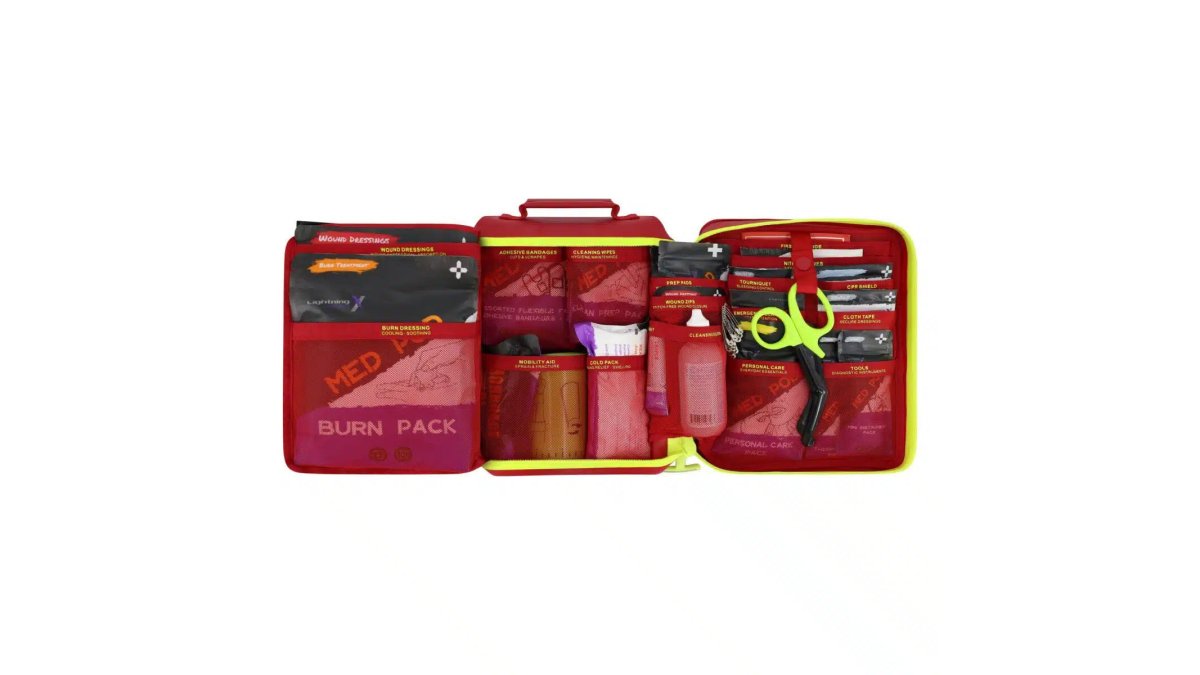
Both the waterproof and soft-case kits carry a tourniquet, an Israeli-style trauma bandage, a roll splint, a CPR mask, and trauma shears. The soft case adds wound closure strips.
Trauma Kit Contents: Bleeding Control, Airway, and Burn Supplies
Trauma-specific supplies differ from general first-aid supplies in one way: they are built for life-threatening injuries. Sterile gauze pads and stretch bandages handle everyday wounds. A tourniquet, haemostatic gauze, a pressure dressing, and a chest seal address severe bleeding and chest trauma.
Supply category |
What to stock |
Quantity for a 6-10 person crew |
Why it matters remotely |
|---|---|---|---|
Bleeding control |
Windlass tourniquet, haemostatic gauze, Israeli-style pressure bandage, chest seal, trauma shears |
2 tourniquets, 2 haemostatic gauze, 2 pressure bandages, 2 chest seals |
Severe bleeding is the leading preventable cause of death in construction trauma; two of each lets you treat a second casualty or a second bleed |
Wound care |
Sterile gauze pads, combine pads, adhesive tape, wound closure strips, nitrile gloves |
10 gauze pads, 4 combine pads, 2 tape rolls, 1 box gloves |
Everyday cuts still need dressing, and gloves protect the responder |
Airway and breathing |
CPR barrier or pocket mask, nasopharyngeal airway, suction bulb |
1 CPR barrier per trained responder, 1 NPA set, 1 suction bulb |
Airway compromise from facial trauma or debris needs support before evacuation |
Burns |
Sterile burn gel, burn dressing, cling film |
2 burn gel sachets, 2 burn dressings, 1 roll cling film |
Burns from hot work, electrical faults, or fuel are common on remote sites |
Eye injury |
Sterile eye-wash pods or bottle, eye pad |
2 eye-wash pods, 2 eye pads |
Dust, grit, and chemical splashes are routine; eye-wash must be immediately reachable |
Fractures and sprains |
Roll splint, triangular bandages, elastic wrap |
1 roll splint, 4 triangular bandages, 2 elastic wraps |
Immobilization before transport reduces further injury |
Hypothermia and shock |
Emergency blanket, instant cold pack |
2 blankets, 2 cold packs |
Exposure and shock are real risks during long evacuations |
Documentation |
Incident log, pen, biohazard bag |
1 each |
A written record supports follow-up care and regulatory reporting |
Our 364-piece kits cover bleeding control, burns, fractures, sprains, CPR, and hypothermia response, and the Med Pod layout groups these categories so a responder can grab the right pod without unpacking the whole case. For a compact, dedicated option, the Servoxy Bleed Control Kit includes a windlass tourniquet, sterile combine pads, nitrile gloves, a triangular bandage, trauma shears, adhesive tape, and a biohazard bag in a polypropylene box.
Burn supplies and eye-wash provisions belong in the main kit or in a dedicated station, depending on your hazard assessment. If hot work, electrical work, or chemical handling happens on site, treat eye-wash and burn supplies as primary, not secondary, and place them at the point of work rather than in the site trailer.
CSA Group guidance on workplace first aid kits
Large Waterproof First Aid Kit IPX7, Labeled Pockets, LXFAK-WP-B+ →
Choosing a Durable Portable First Aid Bag for Crew Size and Hazard
Match the bag to the crew and the hazard, not to the catalogue photo. A small crew on a sheltered site needs far less than a large crew on an exposed, high-risk job.
- Small crew, sheltered site: a soft case with Class B+ contents covers most needs.
- Any crew, wet or dusty site: a waterproof IPX7 case protects the supplies inside.
- Large crew or high-hazard work: a fill-yourself trauma bag lets you stock to your hazard assessment.
IFAK vs AFAK: Which Fits a Remote Construction Crew?
An IFAK, or individual first aid kit, is a compact personal kit one worker carries for self-care or treating a single casualty.

For remote construction, we recommend the AFAK approach for the crew kit and an IFAK for each worker who travels alone.
The Servoxy Bleed Control Kit works well as a compact individual option, while the 364-piece kits serve as the team AFAK.
Inspection, Restocking, and Deployment in the Field
Inspection and restocking are what keep durable gear actually durable. Supplies expire, get used, or get contaminated, and a kit that is not checked is a kit that will disappoint you. The gap most guides leave is the how: how often to check, how to track expiry, how to restock without guesswork, and how to mount the kit so it is reachable in bad weather and poor light.
Inspection intervals that match site conditions
A monthly check is the baseline, but remote and exposed sites need more. Use the table below to set the interval for each kit on site.
Site condition |
Inspection interval |
Extra checks |
|---|---|---|
Sheltered site, low dust, kit stored indoors |
Monthly |
Full contents and expiry check |
Exposed site, dust or rain, kit in a vehicle |
Every two weeks |
Case seal, zippers, clasps, sterile packaging integrity |
High-use kit or after any incident |
Immediately after use, then again at the next scheduled check |
Replace every opened or contaminated item |
Freeze-thaw or extreme heat exposure |
Monthly, plus a seal check after any temperature swing |
Look for cracked plastic, separated adhesives, and condensation inside the case |
Expiry tracking and restocking
Every sterile item carries an expiry date, and tourniquets and haemostatic gauze are the items most often found expired in the field. A simple two-part system works: write the earliest expiry date on the outside of the case, and keep a laminated contents list inside the lid with the quantity and expiry of each item. When you restock, replace from the labeled Med Pods so nothing is missed, and log the date, the person, and what was replaced.
- Check every kit at the interval set for its site condition, and after any use
- Replace expired, damaged, or contaminated supplies
- Confirm tourniquet and dressing packaging is intact
Storage, transport, and deployment
Deploy the kit where the work is, not in a locked office. Mount it on a vehicle headrest, a MOLLE panel, or a central site station, and confirm every worker knows where it lives. On remote sites, three deployment rules matter most:
- Reachability in bad weather: the kit must be reachable with gloves on, in the dark, and in rain. A case with a single large clasp is faster to open than one with a long zipper.
- Visibility: a high-visibility case or a reflective label makes the kit findable when a worker is bleeding and panicking.
- Redundancy: keep a compact bleed-control kit in each vehicle and at each work face, and the main kit at the site station. A single central kit is too far away when the incident happens at the far edge of the site.
For vehicle mounting, a headrest strap or a MOLLE panel keeps the kit secure over rough ground and accessible from the driver's seat. For site stations, a wall-mounted cabinet with a visible label and a posted location map works better than a loose bag in a trailer. Whichever you choose, run a short drill each month so the crew practices finding and opening the kit, not just checking its contents.
Conclusion
Keeping trauma gear ready on a remote site is a maintenance job as much as a purchasing one. The kit that survives is the one with a sealed shell, the right contents for your hazard, and a crew that checks it. Servoxy stocks Health Canada-licensed, CSA-compliant kits and durable trauma bags, backed by more than 20 years serving safety professionals, with nationwide shipping.
Frequently Asked Questions
What should a trauma kit for a construction site include?
A construction site trauma kit should cover serious bleeding, airway, and fracture injuries, not just cuts and scrapes. Look for a windlass tourniquet, haemostatic gauze, an Israeli-style trauma bandage, chest seals, a roll splint, trauma shears, nitrile gloves, a CPR barrier, and an emergency blanket. Add burn dressings and eye-wash supplies where hot work or airborne debris is a hazard. The Servoxy Bleed Control Kit covers the bleeding-control basics in a compact box, while the 364-piece Lightning X kits add splints, CPR masks, and broader trauma supplies for larger crews.
What is the difference between IFAK and AFAK?
An IFAK (individual first aid kit) is a small personal kit sized for one responder, usually built around tourniquet and haemostatic gauze for self-aid or buddy aid. An AFAK (advanced or ambulance first aid kit) is larger and carries broader trauma supplies for treating multiple casualties, often including airway, splinting, and burn items. On a remote construction site, most crews pair each worker with a personal IFAK and keep a larger AFAK-style kit in the site trailer or response vehicle so trauma gear is available at both the individual and team level.
How do you protect medical supplies from dust, moisture, and rough handling?
Choose a case built for the environment: heat-welded TPU with an IPX7 rating for wet sites, or heavy-duty water-resistant nylon with reflective trim for dry but dusty work. Color-coded Med Pods keep supplies organized and reduce digging during an emergency. Store the kit off the ground, out of direct sun, and away from fuel or chemical spills. Inspect seals, zippers, and buckles monthly, and replace any bag showing cracks, broken hardware, or failed closures before the next shift.
How should a remote construction crew store and inspect trauma gear?
Keep trauma gear in a fixed, labeled location in the site trailer or response vehicle, mounted with MOLLE or a headrest attachment so it stays accessible. Assign one person to inspect it monthly and after any incident: check expiry dates, confirm tourniquets and gauze are sealed and undamaged, and restock anything used. Log each inspection so you can show due diligence. On remote sites, keep a second kit in a vehicle in case the trailer is unreachable.
The hard part is not buying gear once. It is keeping every kit stocked, sealed, and ready across scattered sites. Servoxy makes that easier with Health Canada-licensed products, CSA-compliant kit options, and nationwide shipping. Shop our range and equip your crews with gear built to hold up in the field.