


Quick Summary
A small fleet should set one standard for emergency medical kits: group vehicles by role and route, assign each role a kit tier, and carry trauma supplies where response times are long. Assign one named person to check each kit monthly, restock after every use, and track expiry dates.
- Group vehicles by role, since a pool car and a remote crew truck carry different risks.
- Vehicles more than 60 minutes from emergency care need a full trauma kit with a tourniquet and hemostatic gauze.
- Mark each kit with its earliest expiry date so checkers can spot problems at a glance.
- Restock the same day after any use, or tag the kit out of service until it is complete.
- Use first-in, first-out rotation at the depot so supplies do not expire unused.
Table of Contents
- Why Small Fleets Need a Planned Emergency Medical Kit Program
- Sizing Kits for Your Fleet: Vehicle Count, Routes and Risk Level
- Choosing the Right Vehicle Trauma Kit for Each Vehicle Type
- Fleet First Aid Kit Checklist by Incident Type
- Setting Up Kits for Remote Work Sites
- Inspection, Restocking and Expiry Tracking Routine
- Order Your Fleet's Kits and Restocking Supplies from Servoxy
- Frequently Asked Questions
Why Small Fleets Need a Planned Emergency Medical Kit Program
Last Updated: November 1, 2026
Emergency medical kits for small fleets are often an afterthought until a driver is hurt on a job site hours from help.
A small fleet does not need an industrial plant's budget to be prepared. Canadian workplace safety guidance, including the CSA Z1220 standard for emergency response, points employers toward assessing hazards and providing suitable first aid resources, and a fleet is no exception. CSA Group Z1220 emergency response standard
The difference between a planned program and an ad hoc one shows up in three places: consistent contents across vehicles, documented inspections, and a clear path to replace what gets used. Most fleets that skip the planning step end up buying the same kit twice.
Sizing Kits for Your Fleet: Vehicle Count, Routes and Risk Level
Most product pages tell you what is in a kit. Standardizing these requirements across your fleet ensures that every driver remains prepared for the unexpected, a principle that remains just as vital when packing a trauma bag for personal travel.
Size the program in three passes: count vehicles by role, map response time by route, then assign a kit tier to each role. Do not buy one kit type for everything.
Pass 1: Group vehicles by role, not just count
A fleet of 15 vehicles is rarely 15 identical units. Group them into roles that share a risk profile:
- Staff and pool cars: short urban trips, low injury exposure
- Service and delivery vans: loading, lifting, cutting, frequent stops
- Heavy trucks and remote crew vehicles: long routes, late response, higher trauma risk
- Depot and shop vehicles: fixed base, shared by multiple crews
Each role gets a kit tier. A pool car and a remote crew truck should not carry the same kit.
Pass 2: Map response time to kit tier
Response time is the single best predictor of how much trauma supply a vehicle needs. Use a simple three-band map:
- Under 15 minutes to emergency care: compact general first aid kit; trauma supplies optional
- 15 to 60 minutes: compact kit plus a bleed control kit in the vehicle
- Over 60 minutes or remote: full trauma kit with tourniquet, hemostatic gauze, pressure dressings and a written response procedure
These bands are planning aids, not regulatory thresholds. Confirm them against your own hazard assessment and any provincial or territorial first aid requirements that apply to your operation.
Pass 3: Assign a tier to each role
A common pattern for a small fleet is a two- or three-tier structure:
- Tier 1, Compact kit in every vehicle: covers cuts, burns, sprains, eye injuries and minor bleeding. One per car, van and light truck.
- Tier 2, Bleed control kit in higher-risk vehicles: one per service van, heavy truck and remote crew vehicle, mounted or stored where the driver can reach it.
- Tier 3, Depot kit and restock stock: a larger kit at each depot plus bulk replacement supplies so vehicles are never out of service waiting for restock.
For a 15-vehicle fleet, that might mean 15 Tier 1 kits, 5 to 7 Tier 2 kits and one Tier 3 kit per depot. The exact split depends on your role mix, but the principle holds: spend where the risk is, not evenly across the fleet.
Watch out: a kit sized for a desk-based team will run out fast on a crew doing cutting or lifting work. Match the tier to the task, not to the vehicle's sticker price.
Choosing the Right Vehicle Trauma Kit for Each Vehicle Type
Match the kit to the vehicle and the job. Cars need a kit that fits under a seat or in a door pocket. Trucks and vans have room for a larger kit and often carry a dedicated bleed control kit for remote work.
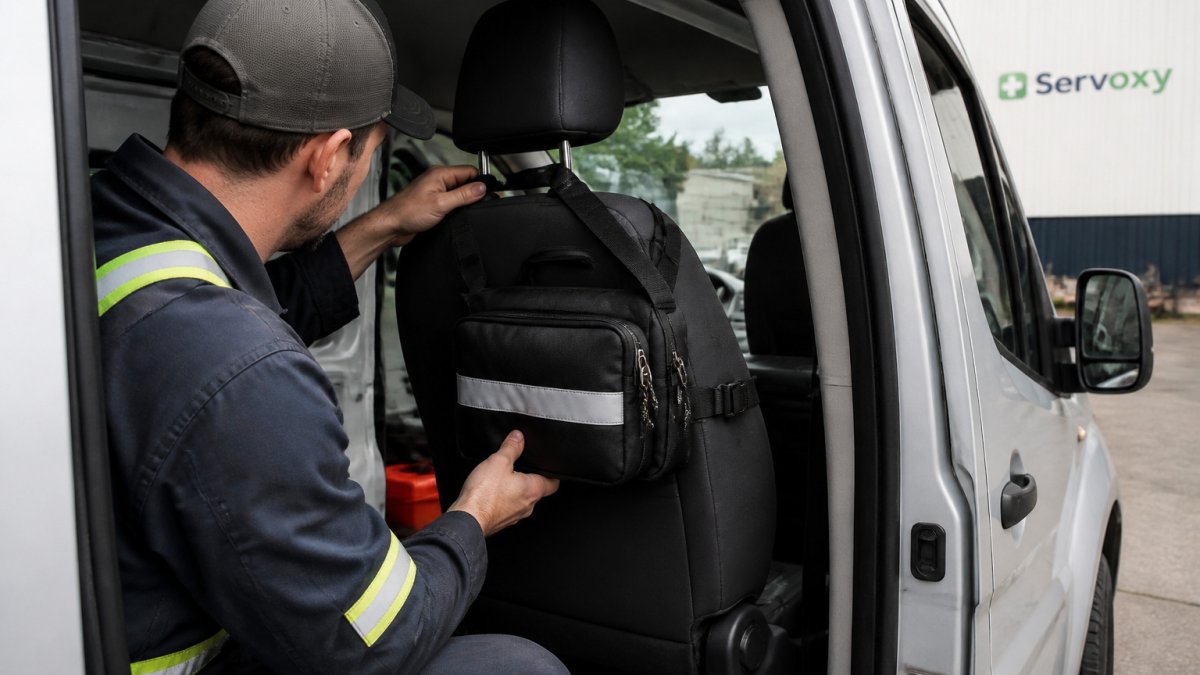
Compact Kits for Cars and Light Vehicles
A compact kit should cover common injuries without taking up cargo space. The Small Soft Case First Aid Kit, LXFAK-SF-A+ at $194.00 CAD contains 269 pieces organized into color-coded pouches, so a driver can find the right supply quickly. For vehicles that face rain or wet conditions, the Small Waterproof First Aid Kit IPX7, LXFAK-WP-A+ at $135.00 CAD is built with heat-welded construction rated to IPX7.


Compact kits suit delivery cars, service vehicles and staff vehicles. They are not a substitute for trauma supplies on heavier work.
Larger Kits for Trucks, Vans and Remote Crews
Trucks and remote crew vehicles need trauma supplies for severe bleeding. The Servoxy Bleed Control Kit at $38.00 CAD includes a Windlass Tourniquet and sterile dressings, and it is designed for emergency bleeding control in workplaces and vehicles. Pair it with a hemostatic gauze such as QuikClot Advanced Clotting Gauze 3″ x 24″ at $46.00 CAD for crews working far from help.
Small Soft Case First Aid Kit,LXFAK-SF-A+ →

Best for: trucks and remote crews where response times are long. Skip if: your vehicles stay within a short drive of a hospital and carry only general first aid needs. (Source: Statistics on workplace injuries)
The article matches each vehicle type to a specific kit, with prices and contents stated for the products it names.
| Product | Price (CAD) | Best for |
|---|---|---|
| Small Soft Case First Aid Kit, LXFAK-SF-A+ | $194.00 | Cars and light vehicles; 269 pieces |
| Small Waterproof First Aid Kit IPX7, LXFAK-WP-A+ | $135.00 | Wet conditions; IPX7 rated |
| Servoxy Bleed Control Kit | $38.00 | Trucks and vehicles; windlass tourniquet |
| QuikClot Advanced Clotting Gauze 3″ x 24″ | $46.00 | Remote crews; hemostatic gauze |
Fleet First Aid Kit Checklist by Incident Type
A fleet first aid kit checklist works best when it is organized by incident rather than by product. Check each vehicle against these groups:
- Cuts and abrasions: sterile dressings, adhesive tape, antiseptic wipes
- Bleeding: tourniquet, hemostatic gauze, pressure dressings, nitrile gloves
- Burns: burn dressings, cool-water gel packs
- Sprains and strains: triangular bandage, elastic wrap, splint
- Eye injuries: sterile eyewash, eye pads
Use this list to compare what each kit contains and to plan restocking.
Setting Up Kits for Remote Work Sites
Remote sites change the math.
Place kits at the point of work, not only in the vehicle.
Watch out: a kit stored in a locked cab or under equipment is useless if the injured worker cannot reach it.
For remote work, many fleets also add a written response procedure that names who calls emergency services, who applies first aid, and how the crew reports the incident.
Inspection, Restocking and Expiry Tracking Routine
A kit is only useful if its contents are current, and across a small fleet the hard part is not the check itself, it is proving the check happened and getting replacements into the vehicle before the next shift. Build the routine around three records: a kit inventory, a check log, and a restock list.
Build the three records first
- Kit inventory: a printed list inside each kit showing every item and its quantity. This is what the checker counts against.
- Check log: one shared sheet or spreadsheet with a row per vehicle and columns for date, checker, missing items, expired items and action taken.
- Restock list: a running list of what has been pulled from the depot stock, so procurement knows what to reorder before the next cycle.
Without the inventory, the check is guesswork. Without the log, you cannot show a pattern of maintenance. Without the restock list, supplies get used and never replaced.
Set the check cadence
- Monthly: count each kit against its inventory list and log any missing items. This catches theft, loss and quiet depletion.
- After every use: restock the same day or tag the kit out of service until it is complete. A used kit that stays in the vehicle is a liability.
- Quarterly: check expiry dates on dressings, gauze, gloves and any sealed supplies. Rotate short-dated stock to the depot and use it first.
- Annually: review kit contents against your hazard assessment and update the program when routes or job types change.
Make expiry tracking practical
Expiry dates are the most common failure point in a fleet program. Two habits fix it:
- Date the kit, not just the items. Mark each kit with the earliest expiry date among its contents, so a checker can see at a glance whether the kit needs attention.
- Use first-in, first-out at the depot. When restocking, pull the oldest stock first and put new stock behind it. This keeps depot supplies from expiring unused.
Connect inspection to procurement
Assign one person to own the routine and give them authority to pull a kit out of service. When the monthly check produces a restock list, that list should feed directly into a bulk order, not a one-off purchase.
A simple pattern that works for small fleets: one named kit owner per depot, one shared log, and one monthly restock order built from the log.
Order Your Fleet's Kits and Restocking Supplies from Servoxy
Servoxy offers first aid kits, a bleed control kit and hemostatic gauze, with nationwide shipping. Start with a vehicle-by-vehicle list, then choose the kit for each category.
Frequently Asked Questions
What should go in a mini first aid kit for a fleet vehicle?
A mini kit for a fleet vehicle should cover the most common incidents: adhesive bandages in several sizes, sterile gauze pads, a triangular bandage, adhesive tape, nitrile gloves, antiseptic wipes, a pair of trauma shears and a pocket face shield for CPR. For bleeding control, add a tourniquet and hemostatic gauze, which the Servoxy Bleed Control Kit and QuikClot Advanced Clotting Gauze provide. Keep the contents listed on a printed inventory so that anyone checking the kit can see at a glance what is missing.
How often should fleet first aid kits be checked and restocked?
Check every fleet kit at least monthly, and after any incident where supplies were used. Each check should confirm that the printed content list matches what is inside, that sterile packaging is intact and that nothing has passed its expiry date. Replace used or expired items the same day, and log the date and initials of the person who did the check. Many fleets pair the monthly check with a vehicle inspection so the task is not forgotten. Your provincial occupational health and safety requirements set the minimum standard for your workplace.
What is the difference between a vehicle first aid kit and a trauma kit?
A vehicle first aid kit handles general injuries such as cuts, scrapes, minor burns and sprains. A trauma kit is built around serious bleeding control, with items such as a tourniquet, hemostatic gauze, pressure dressings and trauma shears. Most small fleets benefit from both: a Class A-style first aid kit in every vehicle, plus a compact bleed control kit in vehicles that travel far from help or carry workers into higher-risk settings. The two kits complement each other rather than replace one another.
How many medical kits does a small fleet need?
A common starting point is one first aid kit per vehicle, plus one trauma kit for each crew or for vehicles that regularly travel beyond easy reach of emergency services. For a fleet of about 15 vehicles, that means roughly 15 general kits and a smaller number of trauma kits, depending on how your crews work. Adjust the count based on your route distances, number of workers per vehicle and the risk level of the tasks performed. Review the numbers each year as your fleet and operations change.
