


Quick Summary
The best emergency kits for remote work cover four areas: first aid, water and food, light and communication, and personal items. Choose by how you work, whether from a fixed home office or in the field, and check expiry dates twice a year.
- Keep at least three days of stored water and shelf-stable food in the kit.
- Check expiry dates twice a year and replace used or expired items the same day.
- The Small Soft Case First Aid Kit costs $194.00 CAD and contains 269 pieces.
- The CSA Z1220-24 Type 1 Personal kit costs $21.00 CAD and is designed for one worker.
- Treat power, connectivity and data as a separate sub-kit with its own supplies.
Table of Contents
- Why Remote Workers Need a Dedicated Emergency Kit
- Remote Work Emergency Kit Checklist: What Every Kit Should Contain
- Comparing the Best Emergency Kits for Remote Work
- First Aid Kits for Remote Workers: Choosing the Right Type and Size
- Mobile Workforce First Aid Kit Options for Field and Vehicle Use
- Emergency Kit for Power Outages, Connectivity and Data Continuity
- Assembling Your Own Kit by Budget and Work Setup
- Choosing Your Home Office Emergency Kit This Week
- Frequently Asked Questions
Why Remote Workers Need a Dedicated Emergency Kit
Last Updated: November 15, 2026
A remote worker's office can be a kitchen table, a van, or a job site far from the nearest clinic. When something goes wrong, the nearest first aid cabinet may be a long drive away. A dedicated emergency kit for remote work puts basic supplies within arm's reach. Servoxy, a Canadian supplier of professional first aid kits and trauma gear, offers CSA-compliant kits for workplace settings. CSA Group Z1220 workplace first aid standard
The gap is real. Many remote workers assume their employer's first aid arrangements follow them home or into the field. A small, self-contained kit can help cover that gap for minor injuries and for the time before help arrives.
Remote work also creates its own risks. A worker alone in a home office may have no one nearby to notice a fall or a cut. A field technician may be hours from a clinic. Power, internet and water can all fail at the same time during a storm. Each scenario calls for supplies that are ready before the emergency.
Canadian Red Cross home emergency preparedness guidance recommends that households plan to be self-sufficient for at least 72 hours. Remote workers can apply the same logic to their workspace. The question is not whether to prepare, but how much to keep on hand and where it should go.
Remote Work Emergency Kit Checklist: What Every Kit Should Contain
A useful kit covers four areas: first aid, water and food, light and communication, and personal items. Keep the list short enough to maintain and complete enough to matter.
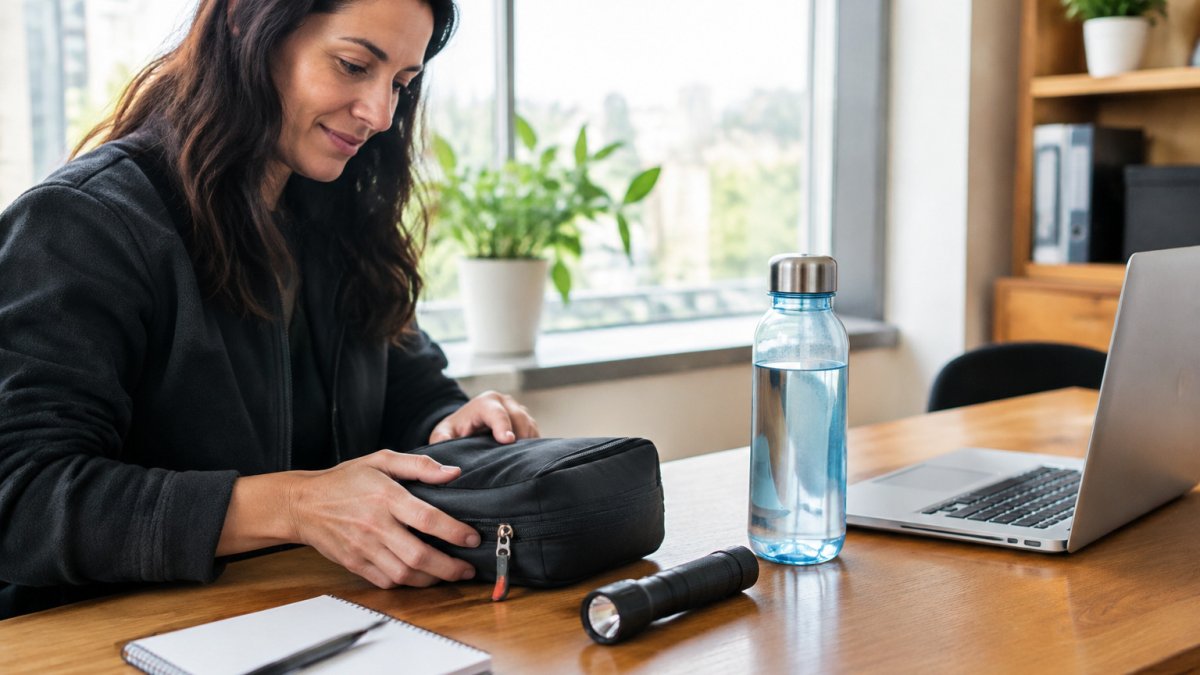
- First aid: bandages, sterile gauze, adhesive tape, antiseptic wipes, nitrile gloves, a triangular bandage and a conforming bandage
- Water and food: stored water and shelf-stable food sufficient for at least three days
- Light and communication: a flashlight with spare batteries and a hand-crank or battery radio
- Personal items: prescription medication copies, a phone charger or power bank, and copies of key contacts and documents
Check expiry dates twice a year. Replace anything used, damaged or past its date the same day. A kit that is out of date is a false sense of security.
Comparing the Best Emergency Kits for Remote Work
Kits differ mainly in size, the number of people covered and whether they are built for a fixed location or for travel. Servoxy's range covers the main options.
| Kit | Price (CAD) | Best For | Pros |
|---|---|---|---|
| CSA Z1220-24 Type 1 Personal Kit (1 worker) | $21.00 | One worker, Québec and Nova Scotia workplaces | Low cost, CSA-compliant, compact nylon pouch |
| Survival Basic Kit (1 person, 3 days) | $85.00 | Food, water and light for home or office | Covers 3 days of food and water, includes flashlight and blanket |
| Waterproof Hi-Vis First Aid Kit | $48.00 | Field work, vehicles and outdoor use | Floats, hi-vis, tamper-evident zippers |
| Small Soft Case First Aid Kit (LXFAK-SF-A+) | $194.00 | Vehicles, job sites and travel | 269 pieces, colour-coded Med Pods, printed inventory list |
Price (CAD)
For a single remote worker who drives, the Small Soft Case kit is a practical option, and its colour-coded pouches and printed inventory list can help with restocking. For a lower-cost option, the CSA Z1220-24 Type 1 Personal kit is designed for one worker. Other providers sell comparable kits, so compare contents and certifications before buying.
First Aid Kits for Remote Workers: Choosing the Right Type and Size
Choose the kit by the work you do. A home office worker needs a compact kit and a water supply. A field technician needs a kit that survives rain and rough handling.
- Personal kits suit one worker who carries their own supplies.
- Class A kits cover common workplace injuries such as cuts, burns and sprains.
- Class B or trauma kits add supplies for serious bleeding and are better for high-risk work.
A common mistake is buying a kit with the most pieces rather than the right pieces. Check the contents list against your likely injuries.
Mobile Workforce First Aid Kit Options for Field and Vehicle Use
Field and vehicle work demands durability and easy access. Two Servoxy options stand out.
The Small Waterproof First Aid Kit (IPX7, LXFAK-WP-A+) costs $135.00. Its heat-welded TPU construction has no stitched seams, and the kit is rated for temporary immersion up to 1 metre for 30 minutes. It contains 269 supplies.
The Tactical LED Flashlight with Belt/Clip costs $15.00. It is an aluminum flashlight with a sliding zoom that runs on AA batteries. (Source: CSA Group Z1220 workplace first aid standard)
For a vehicle kit that also needs hand hygiene, Sani-Hands ALC Antimicrobial Hand Wipes (100 per box) cost $16.50. Each wipe is individually wrapped.
Emergency Kit for Power Outages, Connectivity and Data Continuity
Power and connectivity failures are the most common disruptions for remote workers, and they are the ones general emergency kits ignore. A first aid kit will not keep a laptop alive through a 12-hour outage, and a 72-hour food supply will not restore a hotspot. Treat power, connectivity and data as a separate sub-kit that lives with your first aid supplies.
Power: size the battery to the work, not the label. A phone power bank rated at 10,000 mAh will recharge a phone roughly twice but will not run a laptop. For laptop work, look for a portable power station or a high-capacity USB-C power bank that lists watt-hours (Wh) and can deliver at least 60 W over USB-C Power Delivery. As a rule of thumb, divide your laptop battery's Wh rating by the power bank's usable Wh (typically about 85% of the stated figure) to estimate full charges. Keep two charged USB-C cables and one wall charger in the kit, and store the power bank at about 50% charge if it will sit unused for months; lithium cells age faster at full charge and in heat.
Connectivity: plan for the internet to fail separately from the power. A phone hotspot is the first fallback, so keep a charged phone and a data plan that allows tethering. For longer outages, a dedicated mobile hotspot on a second carrier gives you a different network path. Because outages can disrupt more than connectivity, keep basic safety supplies alongside your backup power and communication tools, and Asknik can help you think through what belongs in that broader home emergency plan.
Data continuity: assume you may have to leave with one bag. Back up work files to an encrypted external SSD or to a cloud service you can reach from a second device, and confirm the backup actually restores before you need it. Keep a printed list of key contacts, account recovery information, and the serial numbers of your main devices. If you evacuate, unplug the workstation, take the external drive, and leave a note for your employer through whatever channel is still working.
Medication and ergonomics belong in this sub-kit too. Keep a seven-day supply of prescription medication where you can reach it in the dark, plus a written list of doses and allergies. A supportive chair cushion or a folding seat in the car helps if you end up working from a temporary location for several days.
A power bank that has been stored in heat for a long time may hold less charge than its label states, so it is worth testing periodically.
Assembling Your Own Kit by Budget and Work Setup
If you prefer to assemble your own kit, start from the checklist above and match it to your setup. The three tiers below assume you already have the first aid basics; the differences are in power, connectivity, and how portable the kit needs to be.
- Home office, low budget (under about $100 CAD): a personal first aid kit, a flashlight with spare batteries, a hand-crank or battery radio, three days of water and shelf-stable food, a 10,000 mAh phone power bank, and a printed contacts sheet. This tier covers cuts, short outages, and the first few hours of a storm.
- Mobile worker, mid budget (about $150-$300 CAD): a Class A kit in a soft case, a hi-vis or waterproof bag for the vehicle, hand wipes, a 20,000 mAh USB-C power bank rated for laptop charging, a second charging cable, and a phone hotspot with tethering enabled. Add a folding seat or cushion if you work from the vehicle.
- Field or remote site, higher budget (about $300-$600 CAD): a waterproof Class A or Class B kit, a trauma-capable kit if the work carries bleeding risk, a survival kit covering three days of food and water, a portable power station in the 200-500 Wh range, a dedicated mobile hotspot on a second carrier, and an encrypted external SSD for work files.
Match the kit to the setup, not just the budget. An apartment dweller with limited storage should favor a compact soft case and a power bank over a large power station, and should know where the nearest stairwell exit is if the elevator is out. A rural or northern worker should assume longer response times and add a second heat source, extra water, and a radio that receives public alert channels. A shared home needs a kit that roommates can find and use without instructions, so label it and post a one-page inventory on the inside lid. A mobile worker who moves between sites should keep a duplicate set of charging cables and a printed contacts sheet in the vehicle so the kit is never left behind.
Maintenance and readiness checks. A kit that is assembled once and forgotten is of little use in an emergency. Put a recurring reminder in your calendar twice a year, ideally at daylight-saving changes, and check four things: expiration dates on food, water, and sterile supplies; battery charge on the power bank, flashlight, and radio; device compatibility, since a new laptop may need a different charger or cable; and the printed contacts and recovery codes, which go stale faster than people expect. Replace anything used, damaged, or past its date the same day.
Compare each kit's contents list against your likely injuries before you buy, and add any missing items. Before committing, review ongoing refill costs and a buying guide so you can budget for restocking.
Choosing Your Home Office Emergency Kit This Week
Start with one kit this week. Choose the personal first aid kit if your budget is tight, or the Small Soft Case kit if you drive for work. Add a flashlight, a radio and three days of water and food. Store the kit where you can reach it in the dark, and note the expiry date on your calendar.
Servoxy supplies CSA-compliant kits, survival kits and trauma gear, with nationwide shipping. Browse the range and choose the kit that matches your work setup today.
Frequently Asked Questions
What should an emergency kit for remote work include?
A remote work emergency kit should cover first aid, water, shelf-stable food for at least 72 hours, a flashlight with spare batteries, a hand-crank or battery radio, copies of key documents, and a backup power source for your laptop and phone. Add prescription medications and a backup of critical files stored off-site. The Survival Basic Kit for one person provides water, food rations, a emergency blanket and a flashlight for three days, which makes a reasonable base to build on with a first aid kit for your workspace.
What is the best first aid kit for remote workers?
The best first aid kit depends on where you work. For a home office or a single worker who travels to job sites, a CSA Z1220-24 Type 1 Personal First Aid Kit at $21.00 covers bandages, gauze, nitrile gloves, antimicrobial wipes and an emergency blanket in a compact nylon pouch. Workers who spend time on water or in wet conditions may prefer the Small Waterproof First Aid Kit IPX7 at $135.00, while a 269-piece soft case kit suits vehicles and larger supply needs at $194.00.
How do you build an emergency kit for a home office?
Start with a first aid kit placed near your workstation, then add water and food for three days for each person in the household, a battery-powered light, and a charged power bank for your devices. Store a printed list of emergency contacts and account recovery details alongside the kit. Check the contents every few months, replacing expired food, water and first aid supplies, and keep the kit in an easy-to-reach location in your home.
What emergency supplies help during a power outage while working from home?
During a power outage, keep a battery-powered or hand-crank radio for updates, a flashlight with spare batteries, and a power bank that is fully charged before storms. A mobile hotspot or a phone with a data plan lets you stay connected if your home internet fails. Store water and shelf-stable food so you are not relying on a fridge or freezer, and back up your work files to cloud storage in advance.
