


Last Updated: October 26, 2026
Quick Summary
A reliable medical supply chain for fleets is the backbone of emergency readiness that ensures consistent availability, proper compliance, and fast replenishment cycles across multiple vehicle locations. Start by standardizing core medical supplies for each vehicle type, establishing a master inventory list, and implementing a two-bin system for high-use items to prevent stockouts during emergencies.
- Track medical supply usage per vehicle for at least 90 days to establish baseline demand forecasts.
- Use the reorder point formula: (average daily usage × lead time in days) + safety stock of 20-30% for critical items.
- Qualify at least one backup supplier before disruptions occur and maintain written contact information.
- Implement lot tracking and conduct monthly expiry audits on a rotating basis across your fleet.
- Choose weekly replenishment for high-call-volume vehicles and bi-weekly or monthly for support vehicles.
Table of Contents
- Why a Reliable Medical Supply Chain Matters for Fleet Operations
- Managing Fleet Medical Supply Inventory Across Multiple Vehicles
- Setting Up a Medical Supply Replenishment Schedule That Works
- EMS Fleet Equipment Procurement: Choosing the Right Supplier
- Stocking Vehicle Emergency Medical Supplies for Field Readiness
- Tracking, Traceability, and Expiry Management Across Your Fleet
- Building Supply Chain Resilience and Contingency Planning
- Starting Your Fleet Supply Chain Today
- Frequently Asked Questions
Why a Reliable Medical Supply Chain Matters for Fleet Operations
A reliable medical supply chain for fleets is the backbone of emergency readiness. When your vehicles are spread across multiple locations, managing medical supplies becomes complex. You need consistent availability, proper compliance, and fast replenishment cycles.
Fleet managers face a hard reality: a missing trauma kit or expired bandage can delay critical care. According to Health Canada's emergency response guidelines, rapid access to appropriate medical supplies directly impacts survival rates in field emergencies.
At Servoxy, we've spent over 20 years helping EMS teams, fire departments, and industrial fleets.
This guide covers how to build that system for your fleet.
Managing Fleet Medical Supply Inventory Across Multiple Vehicles
Inventory management for fleet medical supplies differs from typical stock management. You're not managing one location.
The challenge is visibility.
Start with standardization. Every vehicle should carry the same core medical supplies. This simplifies procurement, reduces waste, and ensures consistency.
Next, establish a master inventory list. You can access Medical Supplies Refills Pack to understand how to maintain and replenish supplies across your fleet. Document exactly what belongs in each vehicle type:
- Ambulances carry full ALS kits
- Response vehicles carry basic trauma supplies
- Support vehicles carry refill packs and backup equipment
Use a simple spreadsheet or dedicated fleet software to track what's in each vehicle. Update it weekly.
Implement a two-bin system for high-use items. When the first bin empties, trigger a reorder for the second.
| Vehicle Type | Core Supplies | Backup Items | Check Frequency |
|---|---|---|---|
| Ambulance | Trauma kit, airway equipment, oxygen | Refill packs, bandages | Weekly |
| Response vehicle | Basic first aid, CPR kit, tourniquets | Gauze, tape, gloves | Bi-weekly |
| Support vehicle | Inventory reserves, equipment maintenance | Replacement items | Monthly |
Setting Up a Medical Supply Replenishment Schedule That Works
A replenishment schedule keeps supplies flowing without overstocking. The goal is predictable, timely delivery, but for fleets, a one-size-fits-all schedule fails because consumption varies by vehicle type, route, season, and call volume.
Forecast Demand by Vehicle, Route, and Season
Start by segmenting your fleet. A paramedic unit running 12 calls per shift consumes trauma supplies far faster than a support vehicle that restocks other units. Track usage per vehicle for at least 90 days to establish a baseline. Then adjust for:
- Call volume: Multiply average supplies used per call by expected monthly call volume for each vehicle type.
- Route profile: Urban routes may see more medical calls; rural routes may have longer transport times and higher oxygen use.
- Seasonality: Winter months often bring more respiratory and cardiac events; summer may see more trauma from outdoor activities. Review last year's data and apply a seasonal multiplier (for example, 1.2x for peak months).
A simple formula: Monthly demand = (average units used per call) × (average calls per month) × (seasonal multiplier). Sum across vehicles to get fleet-wide demand.
Set Reorder Points and Safety Stock with a Formula
Don't guess at reorder points. Use a basic reorder point calculation:
Reorder point = (average daily usage × lead time in days) + safety stock
Safety stock covers demand variability and supply delays. A common approach is to set safety stock at 20-30% of lead-time demand for critical items (tourniquets, airway kits, oxygen masks) and 10-15% for lower-risk items. For example, if a vehicle uses 2 trauma dressings per day and your supplier lead time is 5 days, lead-time demand is 10. With 25% safety stock, your reorder point is 12-13 dressings.
Apply this per vehicle type, not fleet-wide, because lead times and usage differ.
Choose a Replenishment Cadence That Fits Operations
Many fleets use a weekly or bi-weekly cycle, but the right cadence depends on your storage capacity and supplier reliability. Consider:
- Weekly replenishment for high-call-volume vehicles (ambulances, response units) to avoid stockouts.
- Bi-weekly or monthly for support vehicles that carry backup inventory.
- Two-bin or par-level systems for high-use items: when the first bin empties, the second bin triggers a reorder. This visual system works well when drivers are responsible for restocking.
Document the cadence in a shared calendar and assign an owner for each vehicle type. When everyone knows the rhythm, emergency restocking drops.
Align with Supplier Delivery Windows
Work with your supplier on predictable delivery windows. Supply chain best practices from the Canadian Association of Logistics Management emphasize that consistent lead times reduce emergency restocking costs. If your supplier delivers every Thursday, schedule vehicle restocking for Thursday afternoon or Friday morning so vehicles are ready for weekend demand.
EMS Fleet Equipment Procurement: Choosing the Right Supplier
Procurement decisions shape your entire supply chain. The wrong supplier creates delays, inconsistent quality, and compliance gaps.
Evaluate suppliers on five criteria:
Compliance certification. Your supplier must provide CSA Z1220-compliant kits. Request documentation. Don't accept verbal assurances. Health Canada licensing matters. Servoxy is Health Canada-licensed and has provided CSA-compliant equipment for over 20 years.
Lead time consistency. Ask what their typical delivery window is. Can they handle rush orders?
Pricing transparency. Request a detailed price list. Understand what you're paying for. Hidden fees and surprise costs destroy budgets.
Call potential suppliers. Ask specific questions. The ones who answer clearly and quickly are the ones to work with.
Stocking Vehicle Emergency Medical Supplies for Field Readiness
Field readiness means your vehicles are ready when emergencies happen. No delays. No missing equipment.
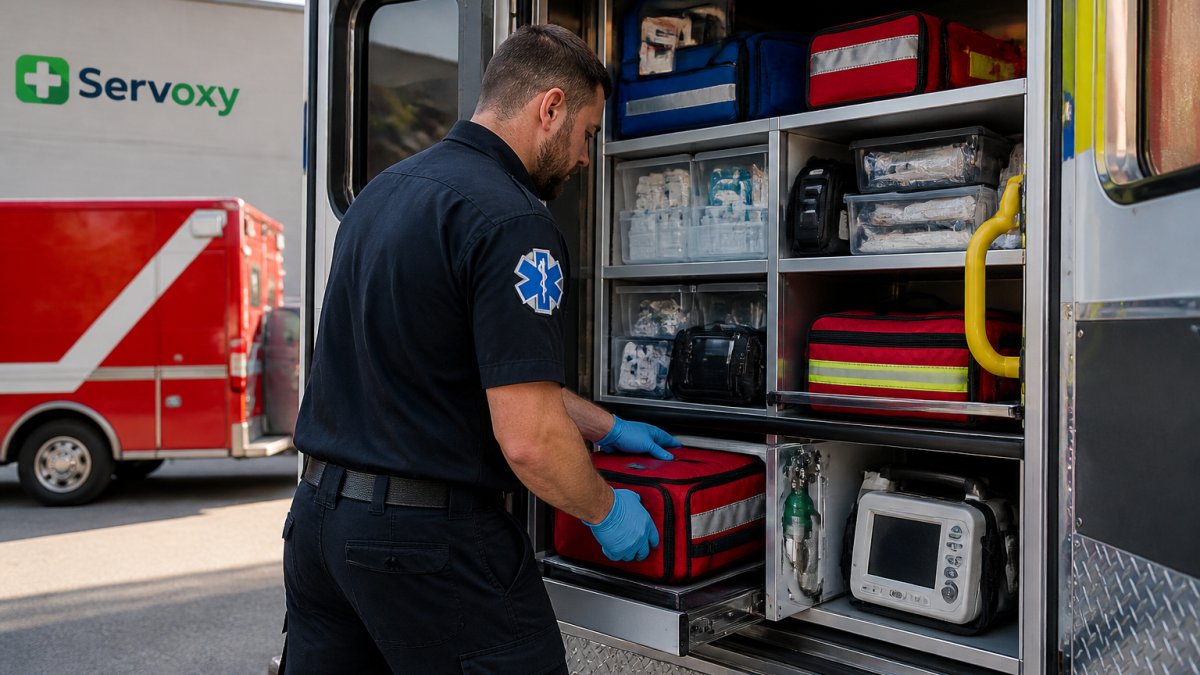
Add role-specific kits. Stock Personal Protection Equipment And Supplies PPE as a critical component of comprehensive fleet medical supply stocking. Paramedics need advanced life support equipment. Support vehicles need refill inventory.
First Aid Kit CSA Z1220-24 Type 1 Personal – 1 Worker | Québec & Nova Scotia →
Organize supplies by function, not by container. During an emergency, speed matters.
CSA Compliance and Supply Selection
Check kit labels. They should state CSA compliance explicitly. If a supplier can't provide documentation, move on.
Storage, Durability, and Environmental Protection
Choose durable containers. Nylon soft cases handle field conditions better than cardboard. Look for water-resistant materials. Guidelines on medical equipment storage from the Canadian Medical Devices Regulations emphasize environmental protection as a compliance factor.
The Lightning X Fluid-Resistant ALS Oxygen Backpack uses TPU material that withstands fluid exposure and harsh field conditions. It's designed for the reality of emergency response, not just office storage.
Check expiry dates quarterly. Rotate stock regularly.
Tracking, Traceability, and Expiry Management Across Your Fleet
Traceability prevents dangerous mistakes.
Implement lot tracking. When you receive supplies, record the lot number and expiry date.
Use a simple tracking system. A spreadsheet works if you have fewer than 20 vehicles.
Assign responsibility. One person should own expiry management. Schedule monthly audits.
Create a disposal protocol. Expired medical supplies can't be used. Don't let them accumulate.
Document everything. Regulators and auditors expect clear records.
Building Supply Chain Resilience and Contingency Planning
Resilience means your supply chain survives disruptions. Suppliers fail. Shipments get delayed. Demand spikes unexpectedly. For fleets, the stakes are higher because a stockout on one vehicle can affect an entire region's response capacity. Mitigating these systemic vulnerabilities requires a proactive strategy focused on improving supply chain resilience across the unique geographic and logistical challenges inherent to the Canadian landscape.
Qualify Backup Suppliers Before You Need Them
Don't wait for a disruption to find a backup supplier. Identify and qualify at least one secondary supplier for critical items (trauma kits, oxygen supplies, tourniquets, airway equipment). Qualification steps:
- Confirm they carry CSA Z1220-compliant kits and can provide documentation.
- Ask about their lead times and rush-order capacity.
- Request a sample order to test quality and delivery reliability.
- Establish a credit account and pricing agreement in advance.
Maintain a written list of backup suppliers with contact names, phone numbers, and lead times. Store it where fleet managers can access it quickly.
Set Shortage Response Triggers
Define what constitutes a shortage and what actions follow. For example:
- Level 1 (low stock): One vehicle type falls below reorder point. Action: place a standard order and monitor.
- Level 2 (critical stock): A critical item is below safety stock across multiple vehicles. Action: contact backup supplier, prioritize allocation to highest-call-volume vehicles, and defer non-urgent restocking.
- Level 3 (stockout): No stock available for a critical item. Action: activate emergency sourcing, borrow from neighboring fleets if agreements exist, and document the incident for review.
Share these triggers with your team so everyone responds consistently.
Build Lead-Time Buffers for Critical Items
Not all supplies need the same buffer. For critical items, consider holding 30-50% more safety stock than standard formula suggests, especially if the item has a long lead time or limited suppliers. For example, if oxygen masks normally have a 7-day lead time, a 14-day buffer may be prudent during flu season or when supplier reliability is uncertain.
Create a Continuity Plan and Test It
Document your contingency plan: backup suppliers, shortage triggers, emergency contact list, and allocation priorities. Then test it. Simulate a disruption, for example, assume your primary supplier is offline for one week. Can you restock all vehicles within 48 hours using backup sources? If not, identify the bottleneck and adjust.
Run a tabletop exercise with your team twice a year. Walk through a scenario and record gaps. Update the plan accordingly.
Communicate the Plan
When everyone understands the backup plan, execution is faster during actual emergencies. Brief drivers on what to do if they notice low stock, and ensure dispatchers know who to contact for emergency restocking.
Starting Your Fleet Supply Chain Today
Building a reliable medical supply chain for fleets takes planning.
Start small. Pick one vehicle type. Standardize its supplies. Track inventory for a month. Once that works, expand to the next vehicle type.
Servoxy provides trauma kits and oxygen equipment.
Get started with Servoxy and build the supply chain your fleet deserves.
Frequently Asked Questions
What medical supplies should a work vehicle carry?
Work vehicles should carry supplies matched to their operational risk. Your choice depends on the crew size, response type, and whether personnel are trained in advanced life support. Servoxy offers a CSA Z1220-24 Type 1 Personal First Aid Kit for one worker for $21.00.
How often should fleet first aid kits be inspected and replenished?
First aid kits should be inspected monthly and after every use. Check expiry dates on medications, sterile supplies, and emergency blankets. Replace any items used, damaged, or expired immediately. For high-use fleets (EMS, fire, tactical teams), quarterly deep inspections and inventory audits are standard practice. A medical supply replenishment schedule tied to your vehicle maintenance calendar ensures consistency across the fleet. Document all inspections and restocking to demonstrate compliance and readiness. Many fleets use checklist systems or inventory management software to track kit status across multiple vehicles.
How can organizations manage medical supply needs across multiple vehicles?
Standardize your fleet's medical supply configuration first: decide on kit types, quantities, and contents for each vehicle class. Use a centralized inventory management system to track stock levels, expiry dates, and usage across all vehicles. Assign responsibility for monthly inspections to individual drivers or a dedicated safety coordinator. Create a reorder trigger (e.g., when usage reaches 30% of kit capacity) and establish a supplier relationship for fast replenishment. For larger fleets, consider a fleet medical supply inventory management system that flags low stock and automates reorder notifications. Regular audits ensure standardization and catch gaps before they affect readiness.
What should fleet managers consider when choosing a medical supply provider?
Servoxy has served EMS, firefighters, and safety professionals for over 20 years and offers a selection of CSA-compliant kits.
Building a reliable medical supply chain for fleets isn't complicated. It requires consistency, clear processes, and the right partner. Servoxy has supported EMS, fire departments, and industrial fleets for over 20 years. Our Health Canada-licensed supplies, CSA-compliant kits, and nationwide shipping mean your vehicles stay ready. Shop our range and see how we can simplify your fleet medical supply management today.
