


Quick Summary
A school emergency medical setup includes a defibrillator, a fully stocked nurse's office kit, bleeding control supplies for sports and trauma, and an allergy response station. These four items come first, and smaller grab-and-go kits for classrooms and field areas build on them. Placement and regular inspection matter as much as the equipment itself.
- Prioritize four items: an AED, a nurse's office kit, a trauma kit, and an allergy cabinet.
- Place the AED where it is visible and reachable, not behind a locked door.
- Size kits to enrolment and building layout, then adjust for incident history.
- Check kits monthly and restock any item used or below half of its stated quantity.
- Fund the AED first, since it is the largest single cost in the plan.
Table of Contents
- Which Emergency Medical Equipment Schools Need Most
- School First Aid Kit Supplies: Quantities for Each Space
- AED for Schools: Choosing and Placing a Defibrillator
- School Trauma Kit and Bleeding Control Supplies
- School Nurse Medical Supplies and Allergy Response
- Placement, Inspection and Restocking Schedules
- Budgeting Your School Emergency Equipment Plan
- Set Up Your School's Emergency Equipment This Term
- Frequently Asked Questions
Which Emergency Medical Equipment Schools Need Most
Last Updated: November 8, 2026
Every Canadian school needs a working first aid kit, a way to reach emergency help, and a plan for the injuries and medical events that happen on campus. A school emergency medical equipment setup covers more than a box in the office.
Start with the highest-consequence items. A school should have a defibrillator for sudden cardiac arrest, a fully stocked kit in the nurse's office, a bleeding control kit for sports and trauma, and an allergy response station for students with known anaphylaxis. Everything else builds on those four.
Here is a practical priority order for most schools:
- Automated external defibrillator (AED): placed in a known, visible location with a clear signage and a staff member trained to use it.
- Nurse's office first aid kit: a CSA-compliant kit sized to staff and student numbers.
- Trauma and bleeding control supplies: tourniquets, pressure dressings and gloves for sports fields and gyms.
- Allergy emergency cabinet: wall-mounted storage for epinephrine auto-injectors, with signage that students can recognize.
- Classroom and field kits: smaller grab-and-go kits for areas away from the health room.
Requirements for school first aid and emergency equipment can vary by school board and province, so check local rules before buying. Keep records of what you purchase, where each item sits and when it needs replacing. This documentation becomes important during an inspection or an incident review.
School First Aid Kit Supplies: Quantities for Each Space
A school first aid kit is only useful if it has enough supplies for the people who use it. A kit sized for a small office will run out quickly in a school of several hundred students. You can compare Canadian-standard kit sizes for a specific headcount before choosing.
Plan your kit quantities around three questions: how many people the space serves, how often injuries happen there, and how far the space is from the health room. A gymnasium or sports field needs more trauma and wound care supplies than an administrative office. A science lab needs eye irrigation supplies. For eye wash and irrigation, the Eyewash Solution, Full Bottle, 500 ml is a sterile, ready-to-use option that suits lab and first aid stations.
A practical way to size kits is to work from enrollment and building layout rather than from a single product label. Use the following planning ranges as a starting point, then adjust for your own incident history and provincial or board requirements:
- Health room or nurse's office (primary kit): one large, CSA-compliant kit per school, plus a backup consumables bin. Quantities should be set by a risk assessment for your school's enrolment and incident history.
- Each classroom or satellite space: one small grab-and-go kit for first response before the health room is reached.
- Gymnasium and sports field: one trauma-oriented kit suited to sports injuries. Add a second kit if the field is a separate building or a long walk from the gym.
- Science lab: one kit with eye irrigation supplies, plus standard wound care and gloves. Check that the eyewash is within the lab's safety station, not stored in a locked cabinet.
- Bus and field trip kit: one compact kit per bus or per trip group, with core wound care supplies and a biohazard bag. Field trip kits should be checked out and returned so they are not left on the bus indefinitely.
Core supplies every school kit should include:
- Adhesive bandages in several sizes, including fingertip and knuckle sizes
- Sterile gauze pads and compress bandages
- Medical tape and conforming bandages
- Disposable nitrile gloves, in the sizes staff actually use
- Antiseptic wipes or swabs
- Instant cold packs
- Triangular bandages and a splint set
- Scissors, forceps and a CPR face shield with a one-way valve
- Biohazard disposal bags
Restock the kit after every use and record what was taken. Schedule a monthly check, and reorder items when stock runs low. Watch out: a kit that is stored in a locked cabinet without a key accessible to staff on every shift can be effectively unavailable during an emergency.
AED for Schools: Choosing and Placing a Defibrillator
An AED is the single most important piece of school emergency medical equipment. Sudden cardiac arrest can happen to anyone, and survival depends on defibrillation within minutes (Cardiac arrest (Cardiopulmonary arrest)). Schools should choose a unit that staff can use without extended training, that stays ready on the wall, and that is easy to find under pressure.
Several AED packages from Servoxy may suit school settings:
- ServoxyInc Defibrillator AED-DEA Package for Canadian Business, Office, Workplace, Arena-Pool, School-Government is a HeartSine Samaritan 360P package priced at $2,400.00. The listing includes an alarmed cabinet, a carrying case, a fast response kit and bilingual signage, with an 8-year manufacturer warranty.
- Philips HeartStart OnSite AED Defibrillator Kit is priced at $1,939.00. It includes voice-guided instructions for adults and children, pre-installed battery and pads, and a wall hook for visible mounting.
- ZOLL AED 3 Defibrillator with Fast Response Kit is priced at $2,555.00 and includes universal CPR Uni-padz that work on both adults and children.
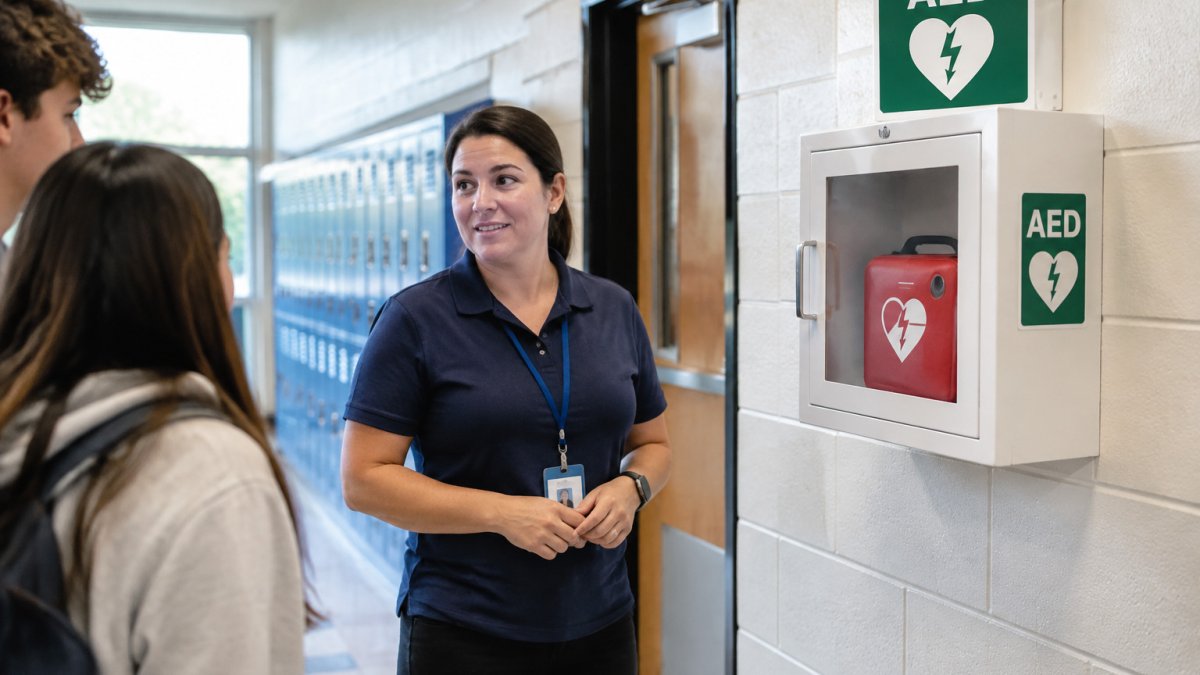
Placement matters as much as the model you choose. Mount the AED near the main entrance or gymnasium, at a height that is visible and reachable, and keep it out of direct sun and extreme temperatures. Label the location with signage, and make sure every staff member knows where it is.


Watch out: an AED kept in a locked room or behind a closed office door can cost minutes that matter. Choose a location that is accessible during every school period, including after hours for events.
Price of AED packages for schools
School Trauma Kit and Bleeding Control Supplies
Sports fields, gymnasiums and playgrounds produce serious bleeding injuries. A school trauma kit should be built for those situations, with supplies that stop bleeding quickly and protect the responder. The Ultimate Sports First Aid Kit, priced at $140.00, is designed for track, team sports and playground use. It comes in a weather-proof utility box with lift-out trays.
For a more compact option, the Nexcare Office First Aid Kit, a Class 2 medical device with 64 pieces in a plastic box, priced at $42.00, suits a staff room or a classroom. Pair either kit with a Combat Application Tourniquet, which is included in the CSA Z1220-24 Type 2 kit, for a bleeding control setup that covers severe limb injuries.
Keep trauma kits near high-risk areas, and make sure staff know how to apply a tourniquet and a pressure dressing. Training is an important part of any emergency plan.
School Nurse Medical Supplies and Allergy Response
Schools with students who carry epinephrine auto-injectors need a dedicated storage and response plan. The Allergy Emergency Cabinet Kit is a wall-mountable metal cabinet priced at $74.98. It holds up to two epinephrine injector pens, which must be purchased separately, and includes a green safety sign and a tamper-evident bilingual seal. The cabinet is built for schools, offices, gyms and public spaces, and it mounts on cinder block or drywall with included anchors.
The nurse's office may also keep a non-contact infrared forehead thermometer, priced at $29.99, for routine health checks. It stores the last 32 readings and has an adjustable high-temperature alarm.
Allergy response depends on quick recognition. Each student with a known allergy should have an individual action plan on file, and staff should know where every auto-injector is stored. Check expiry dates at the start of each term, and confirm that any cabinet signage remains visible.
Placement, Inspection and Restocking Schedules
Equipment is easier to keep ready when someone is responsible for it. Assign one staff member to each equipment category, and give them a written schedule for inspection and restocking. A practical schedule looks like this:
| Equipment | Check frequency | Restock trigger |
|---|---|---|
| AED | Daily visual, monthly full check | Any warning indicator or pad expiry |
| First aid kits | Monthly | Any item below half of stated quantity |
| Trauma and bleeding kits | Monthly | Any tourniquet or dressing used |
| Allergy cabinet | Start of term and monthly | Any auto-injector expired or used |
| Eyewash | Monthly | Bottle opened or frozen |
A schedule only works if it is tied to a simple inventory process. Keeping that map current also helps district teams coordinate equipment checks across campuses, a responsibility that fits within broader emergency preparedness planning with reUNITEme™.
The per-item log can be a paper sheet taped inside each kit or a shared spreadsheet. Record the date of each check, who performed it, what was used or missing, and what was reordered.
The termly audit is a deeper check at the start of each term. Walk the building with the placement map, open every kit, confirm the contents match the documented list, check expiry dates, and test that AED status indicators show ready.
Restocking should be triggered by use, not only by the calendar.
Post the inspection log in the health room, and file a copy with the school board's health and safety records.
Budgeting Your School Emergency Equipment Plan
Begin with the items that carry the most risk, then build outward. A reasonable first-year purchase for a mid-sized school might include one AED, one CSA-compliant kit for the nurse's office, one sports trauma kit, one allergy cabinet and signage for each. The AED is the largest single cost, so fund it first.
Compare the total cost of a kit with the cost of buying each component separately. A complete kit often costs less than assembling one from individual items, and it arrives with a consistent set of supplies that matches the kit's documented contents. Include replacement costs in your budget: pads, batteries, dressings and epinephrine all expire and must be replaced on a schedule.
Ask your school board whether capital funds cover AEDs and cabinets, and whether operating funds cover consumables. Many boards split these budgets, and planning the purchases around both can prevent gaps.
Set Up Your School's Emergency Equipment This Term
Pick one priority this term, whether that is the AED, the nurse's office kit or the allergy cabinet, and complete it before moving to the next. Assign an owner for each item, put the inspection schedule on the calendar, and walk the building to confirm that every location is visible and reachable.
Servoxy supplies CSA-compliant first aid kits, AED packages, allergy cabinets and related signage for Canadian schools. Browse the range and choose the configuration that fits your building, or contact us to talk through quantities for your student and staff numbers.
Frequently Asked Questions
What emergency medical equipment should every school have?
At minimum, a school should have a stocked first aid kit in each main area, a wall-mounted AED in a central location, a trauma or bleeding control kit, and epinephrine auto-injector storage where students with severe allergies attend. The Servoxy Allergy Emergency Cabinet Kit, priced at $74.98, is designed to hold up to two epinephrine injector pens, which are sold separately. Adjust quantities to enrolment, building size and your provincial workplace first aid requirements, and confirm them with a risk assessment.
What should be included in a school first aid kit?
A practical school first aid kit covers adhesive bandages, sterile gauze pads, medical tape, antiseptic wipes, disposable nitrile gloves, a CPR shield with a one-way valve, bandage scissors, instant cold packs, a splint, and a biohazard disposal bag. The CSA Z1220-24 Type 2 Small First Aid Kit for 2 to 25 workers is priced at $52.00 and includes a CPR shield, nitrile gloves and a tourniquet, which makes it a useful reference point for staff-area kits. Review contents against your local first aid standard before purchase.
Do schools need an AED?
Many schools choose to install one because sudden cardiac arrest can happen to students, staff and visitors without warning, and early defibrillation combined with CPR gives the best chance of survival. Servoxy offers several AED packages, including the ZOLL AED 3 with a Fast Response Kit at $2,555.00 and the Philips HeartStart OnSite AED Defibrillator Kit at $1,939.00, the latter including a bonus CSA Type 2 first aid kit. Staff should be trained to use it, and the unit should be checked on its self-test schedule.
