


Last Updated: November 7, 2026
Quick Summary
Eyewash stations for remote construction sites are self-contained or portable flushing units that rinse chemicals, dust, or debris from a worker's eyes within seconds, long before an ambulance could arrive. Choose gravity-fed units for short jobs without a water line, cartridge units for longer jobs, and saline bottles only as backup.
- Wet concrete and mortar are alkaline and can burn eye tissue on contact.
- A gravity-fed unit holds its own water supply with no plumbing or power needed.
- The Pure Flow 1000 delivers a constant 15-minute flow at 0.4 gpm.
- The 1 oz. saline bottles do not meet the CSA Z94.4-15 15-minute flushing requirement.
- Inspect stations weekly on an active site and after any use, move, or refill.
Table of Contents
- Why Remote Construction Sites Need Eyewash Stations
- Construction Site Emergency Eyewash Requirements
- Portable Eyewash Stations for Construction: Types and Options
- Choosing a Station for Temporary and Remote Worksites
- Placement, Travel Time, and Capacity Planning
- Portable Eyewash Station Maintenance and Seasonal Operation
- Eyewash Station Inspection Checklist and Documentation
- Stocking Your Site with Servoxy Eyewash Stations
- Frequently Asked Questions
Why Remote Construction Sites Need Eyewash Stations
Eyewash stations for remote construction sites are self-contained or portable flushing units that let a worker rinse chemicals, dust, or debris from their eyes within seconds, long before an ambulance could arrive. On a remote jobsite, a plumbed station may be kilometres away and the nearest hospital further still. Portable eyewash stations for construction close that gap; this guide covers how to choose, place, and maintain them.
Hazards That Put Eyes at Risk on Site
The most common eye hazards on a construction site are chemical splashes, airborne dust, and flying debris. Wet concrete and mortar are alkaline and can burn tissue on contact.
Windblown dust and sand add a slower, grinding risk; even a small particle under the eyelid can scratch the eye. Eye and face protection reduces the risk but does not remove the need for a station.
What Emergency Eyewash Stations Actually Do
An emergency eyewash station delivers a controlled flow of clean water or sterile flushing fluid to both eyes at once. It exists for on-the-spot decontamination: the first seconds of eye irrigation matter most, and flushing at the point of exposure is faster than walking to a sink.
These units rinse contaminants from the eye and face so a worker can then get medical help. They do not replace first aid training or emergency response planning. They buy time.
Construction Site Emergency Eyewash Requirements
Construction site emergency eyewash requirements in Canada flow from provincial occupational health and safety rules and from the applicable CSA standard for emergency eyewash equipment. Because emergency eyewash is only one part of site preparedness, aligning its placement and maintenance with broader industrial safety requirements helps keep hazard controls consistent across remote work areas.
- Immediate access: a station within a short travel time of the hazard, on the same level where practical
- Clean flushing fluid: water or sterile solution, never a stagnant or contaminated supply
- Hands-free activation: the worker's hands stay free to hold the eyes open
Always confirm the exact wording with your provincial regulator and your site's health and safety plan. Rules vary by province, and the employer carries the duty to assess and control hazards.
Portable Eyewash Stations for Construction: Types and Options
Portable eyewash stations for construction fall into three practical groups: gravity-fed units, self-contained cartridge units, and bottled eyewash. Each suits a different stage of a job.
Gravity-Fed and Self-Contained Units
A gravity-fed system holds its own water supply in a tank above the nozzles: no plumbing, no power, no water line. Fill it, mount it, and it is ready, the workhorse for a temporary jobsite without a plumbed source.
The Bradley On-Site gravity-fed eyewash station is a gravity-fed option with a 7-gallon (approximately 26 L) capacity, a high-visibility yellow pedestal, a transparent tank for checking solution level, and a hinged tray that activates in one motion.

Self-contained cartridge units collect the used fluid for easy cleanup and need no plumbing. The Pure Flow 1000 eyewash station delivers a constant 15-minute flow at 0.4 gpm, carries a 24-month cartridge life, and includes an emergency sign, hanging bracket, and inspection tag.
Bottled eyewash and personal bottles
Bottled eyewash is a backup, not a primary station. A 1 oz. saline bottle fits in a first aid kit, a vehicle, or a tool bag, and it lets a worker rinse dust or grit on the move.
Be clear about the limit. The 1 oz. saline eyewash bottles do not meet the CSA Z94.4-15 15-minute flushing requirement. For refilling gravity-fed units, keep 500 ml eyewash solution on hand so a station is never dry when needed.


| Option | Water Supply | Best For | Key Limit |
|---|---|---|---|
| Gravity-fed unit | Self-contained tank | Fixed temporary jobsite | Needs refill and preservative |
| Cartridge unit | Sealed cartridge | Longer jobs, easy cleanup | Cartridges sold separately |
| Saline bottle | 1 oz. single use | Kits, vehicles, backup | Not 15-minute compliant |
Choosing a Station for Temporary and Remote Worksites
Choosing a station starts with a short hazard assessment, not a catalogue. Work through the framework below in order, because each answer narrows the next choice.
Step 1: Classify the eye hazard
Match the station to what can actually reach an eye, not to the general category of construction work.
- Chemical splash risk (wet concrete, mortar, solvents, adhesives, sealants): you need a plumbed or self-contained unit capable of a full 15-minute flush, with hands-free activation. A saline bottle is not adequate as the primary response.
- Airborne dust and fine particles (grinding, cutting, sweeping, windblown sand): a gravity-fed or cartridge unit near the work front, plus saline bottles in vehicles and tool bags for grit on the move.
- Flying debris (chipping, drilling, fastening): the primary control is eye and face protection, but a station still belongs within a short walk because protection can fail or be worn incorrectly.
Step 2: Size for simultaneous exposure, not headcount
Capacity planning is about how many workers can be exposed at the same moment, not how many are on the payroll.
A practical rule most safety practitioners use: one station per distinct hazard zone, plus one backup unit that stays ready while the primary is being serviced or refilled. On a remote site, the backup is not optional, because replacing a drained gravity-fed tank can take hours you do not have.
Step 3: Match the unit type to job duration and servicing access
| Site profile | Practical choice | Why |
|---|---|---|
| Short job, days to a few weeks, no water line | Gravity-fed unit with preservative | No plumbing or power, quick to set up and move |
| Longer job, weeks to months, limited cleanup capacity | Self-contained cartridge unit | Sealed fluid, collected waste, predictable service interval |
| Mobile crews and vehicles | Saline bottles as backup only | Portable, but not a 15-minute primary station |
| Cold-season or unheated storage | Drainable or heated-space unit | Prevents freeze damage and unusable flushing temperature |
The Bradley On-Site gravity-fed eyewash station fits the short-job, no-plumbing profile: a 7-gallon (approx. 26 L) tank, a transparent reservoir for level checks, and a one-motion hinged tray. The Pure Flow 1000 eyewash station provides a constant 15-minute flow and a 24-month cartridge life, though cartridges are sold separately, so build that into your refill plan. A single eyewash station with solution can cover a small crew on a short job, but treat it as a starter unit rather than a site-wide solution.
Step 4: Confirm the compliance fit before you buy
Check the unit against CSA Z94.4-15 and your provincial regulator's wording, then confirm three things in writing: the unit delivers a full 15-minute flush, activation is hands-free, and the manufacturer's service interval is realistic for how often you can actually reach the site. A station that meets the standard on paper but cannot be serviced on your schedule will fail in practice.
Best for: small crews on short jobs with dust or debris hazards. Skip if: several workers share one chemical hazard zone at once, or the site runs through winter without heated storage.
If your crews also need broader field-ready medical gear, our article on durable trauma gear for remote construction sites covers that side of the kit.
Placement, Travel Time, and Capacity Planning
Placement is where most sites get it wrong.
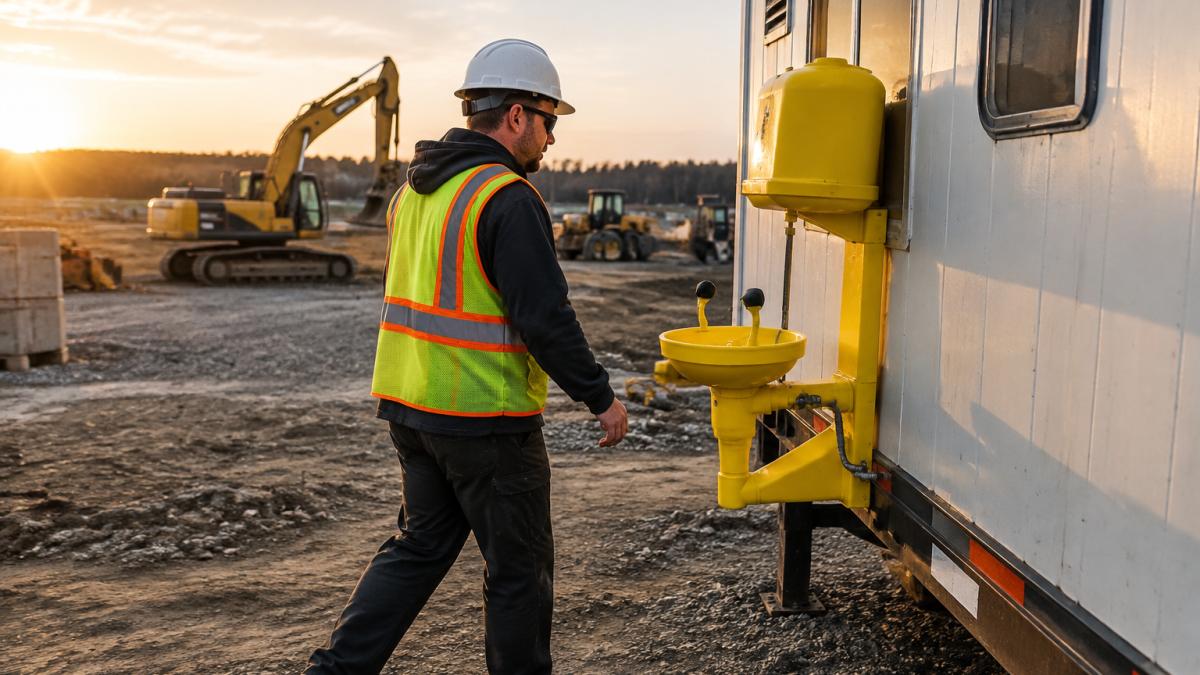
Plan travel time, not distance. A station 20 metres away behind a fence is worse than one 30 metres away on open ground. Walk the route yourself, in boots, and time it.
Capacity planning follows the same logic. If a crew of ten works one chemical mixing area, one station may be enough.
Portable Eyewash Station Maintenance and Seasonal Operation
Portable eyewash station maintenance is the part that quietly fails. A unit that sat full and untouched for months is not a working station. On a remote site the challenge is building a routine you can actually execute when the nearest supply run is hours away. The plan below covers water quality, refill logistics, service intervals, and seasonal operation.
Water quality and refill logistics
Gravity-fed units hold water on site, so the water is only as good as your refill process. Gravity-fed units typically need a water preservative.
For refill logistics on a remote site:
- Stage stock before the site opens. Keep spare preservative, spare cartridges, and at least one full refill of 500 ml eyewash solution on site or in the site vehicle.
- Use clean containers. Refilling a tank with a dirty hose or bucket contaminates the fluid and defeats the purpose of the station.
- Match the fluid to the unit. Gravity-fed tanks take water with the preservative specified by the manufacturer; cartridge units take the manufacturer's sealed cartridge. Do not substitute one for the other.
Watch out: a tank topped up with water but no preservative can grow bacteria and become a hazard in its own right, so treat preservative as part of the refill, not an optional extra.
Service intervals and what to check
Set intervals by site activity, not by calendar convenience. On an active site, inspect weekly and after any use, move, or refill. At each service:
- Flush the unit to move the fluid and confirm even flow from both nozzles.
- Check seals, the activation tray, and the tank for stiffness, cracks, or leaks.
- Verify the fluid is clean, in date, and at a usable temperature.
A signed tag and a log show the station was checked, and they flag a unit that keeps failing so you can replace it rather than keep servicing it.
Freeze protection and seasonal operation
Winter is the hard season for remote sites. A gravity-fed tank left in an unheated trailer can freeze and crack, and flushing with near-freezing water is painful enough that a worker may cut the flush short.
- Drain and store units that will not be used through the cold months, following the manufacturer's winterization steps.
- Keep active units in a heated space or use a unit rated for the temperature range you expect.
- Insulate or shelter the unit where it must stay outdoors, and check it after every cold snap.
Seasonal operation is not only about winter. In hot weather, water left in a tank can warm and stagnate faster, so increase inspection frequency and confirm the preservative is still within its interval.
Eyewash Station Inspection Checklist and Documentation
An eyewash station inspection checklist turns good intentions into a record. Inspect weekly on an active site, and after any use, move, or refill. Use this list:
- Station is in its marked location and the path is clear
- Activation works with one motion, hands-free
- Fluid level is visible and within range
Documentation protects the crew and the employer. A signed tag and a log show the station was checked, and they flag a unit that keeps failing. Pair the log with a short worker training refresher so the station is known, not just present.
Stocking Your Site with Servoxy Eyewash Stations
Every remote site eventually faces the same test: a worker gets something in an eye, and the clock starts. The station, the fluid, and the training either hold up or they don't.
A station is only as good as the routine behind it. If you are building out a remote site's emergency kit, our team can help you match units, fluid, and backups to your hazards and crew size.
Frequently Asked Questions
What type of eyewash station is best for a remote construction site?
A self-contained or gravity-fed portable eyewash station works best where no plumbed water supply exists. Look for a unit that delivers a full 15-minute flush, has a visible fill-level indicator, and can survive transport between mobile work areas. The Bradley On-Site gravity-fed station, with its 7 gal (approximately 26 L) capacity and stainless steel transport clamps, fits this role. Bottled eyewash is a supplement, not a substitute, because it cannot meet the 15-minute flushing requirement.
When should a construction site have an emergency eyewash station?
Provide one wherever a hazard assessment identifies a risk of chemical splash, dust, or flying particles that could injure eyes. On remote sites, that usually means any task involving concrete additives, solvents, adhesives, or cutting and grinding. Place the unit so a worker can reach it quickly, on the same level, with an unobstructed path. Document the assessment and review it whenever the work front moves.
Can a portable eyewash station be used without a plumbed water supply?
Yes. Gravity-fed and self-contained stations hold their own flushing fluid, so they need no plumbing, no power, and no drain connection. The Pure Flow 1000, for example, collects used solution in its own basin for easy cleanup. The trade-off is refill logistics: you must track fluid levels, replace cartridges on schedule, and haul replacement fluid to isolated locations. Build that resupply into the site plan before the crew arrives.
What should a remote jobsite eyewash station inspection include?
Check fluid level and expiry, confirm the activation mechanism moves freely, inspect nozzles and covers for debris or damage, verify the unit is upright and secure, and confirm the path to it is clear. Run a brief functional flush to prove flow. Record the date, initials, and any corrective action on a tag or log. Confirm the exact inspection interval with your provincial regulator and the applicable standard.
